

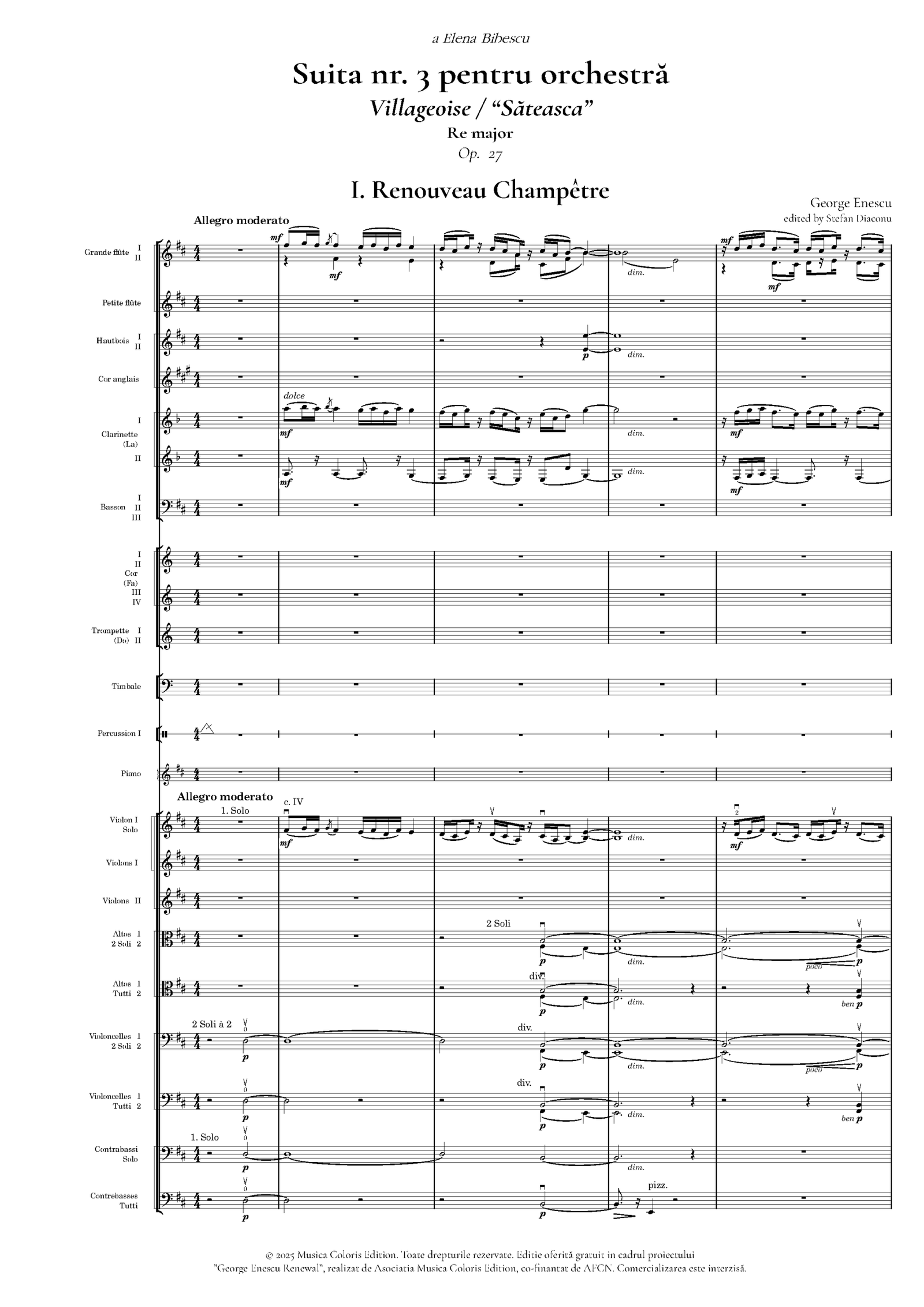
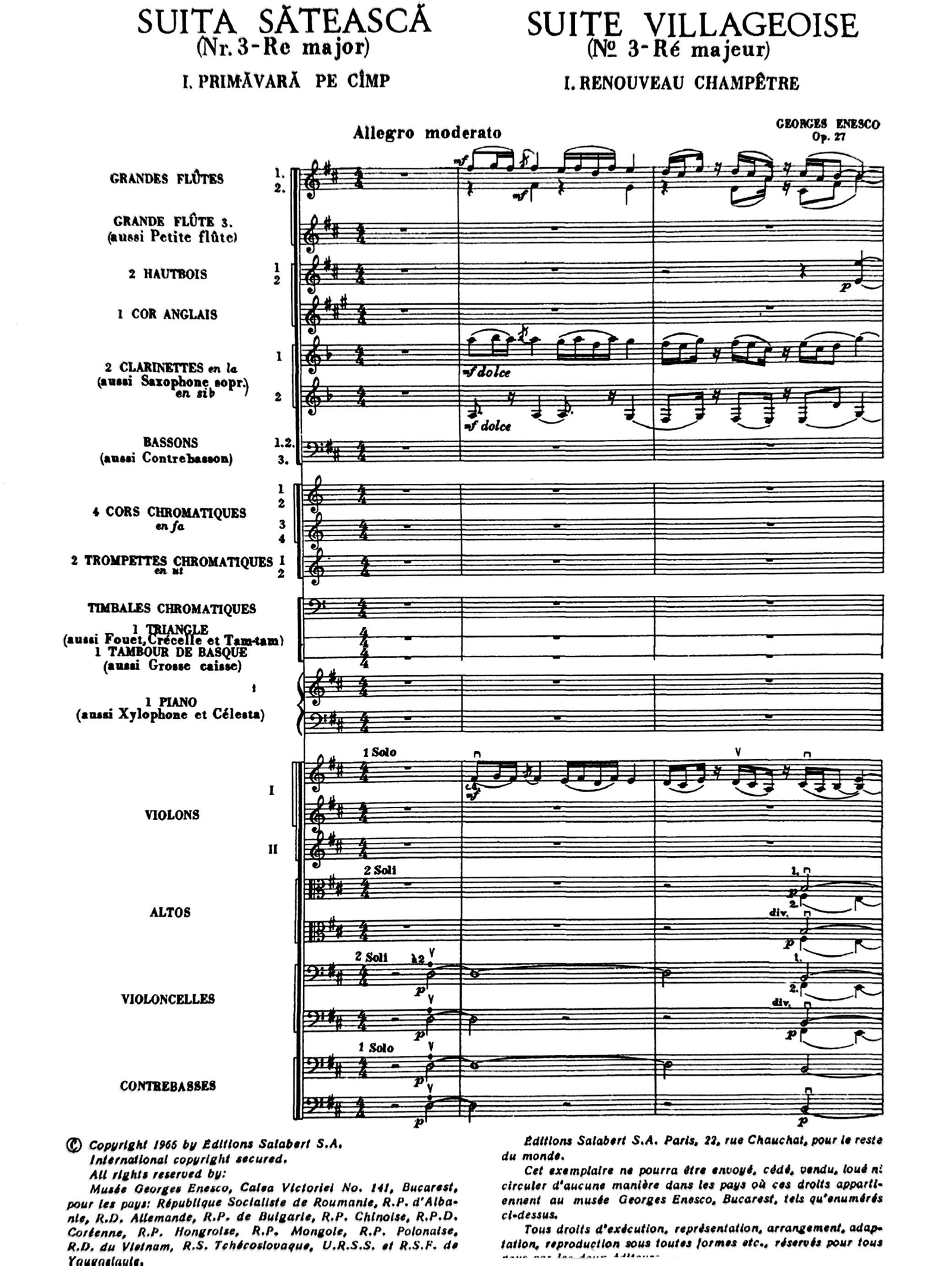
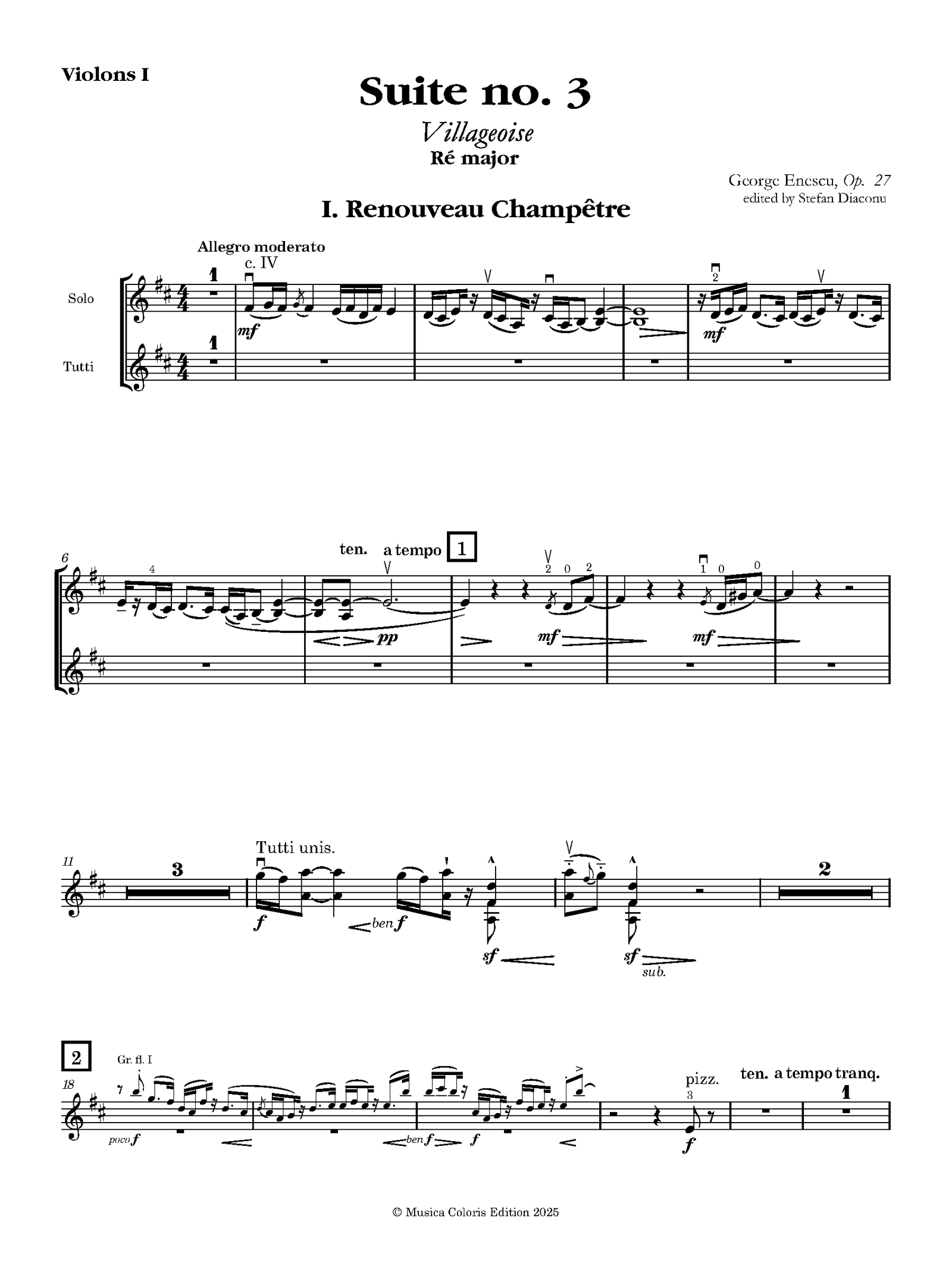
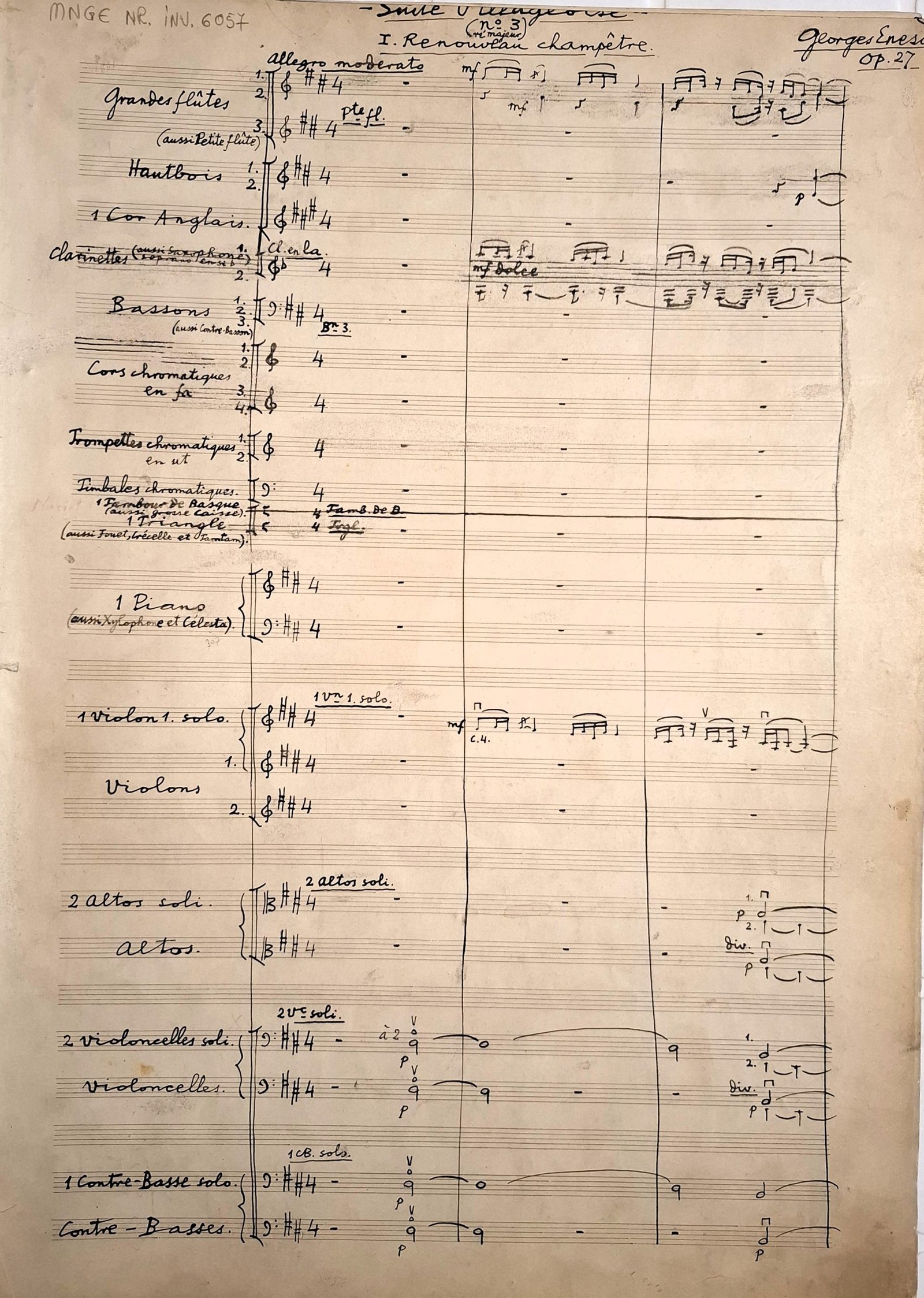
Orchestral Suite no.3, “Villageoise”, in D major, op. 27
0,00 €
- The first modern Urtext edition, based on the final versions of Enescu’s revised manuscripts, including his handwritten conducting indications
- Orchestral parts in a large format (9 × 12 inch) with practical page turns
- Score in large format – A3
- Foreword detailing the origins of the composition, its premiere, and an analysis of the musical material by Vlad Văidean, a musicologist with expertise in the works of George Enescu (English, French, Romanian)
- Alternative B-flat Bass and E-flat Piccolo clarinet orchestral parts for original transposition: Bass clarinet in A and Piccolo clarinet in D
- Separate parts for Soprano Saxophone in B-flat with additional voice for transposed Sopranino Saxophone in B-flat
- Percussion parts reorganised in a clear and easy to perform manner
- Piano part reorganised; Glockenspiel redistributed to a dedicated percussion part
- Stand-alone off-stage parts
- Playing directions in French and English
Explore the score history
Enescu’s programmatic style carries a deeply autobiographical essence, expressed either explicitly through descriptive titles or implicitly through evocative musical atmospheres. Clemansa Liliana Firca identified a “constant of return” in his work—a tendency to revisit the formative experiences and landscapes of his childhood, particularly the Romanian countryside and its “natural” musical language. This spiritual coincidence between nature and music becomes especially vivid in his later works, notably Impressions d’enfance, Op. 28, and Suite No. 3, Op. 27, which poetically evoke the summer nights of his Moldavian youth. In Suite No. 3, Enescu revisits the concept of Poème roumain, Op. 1, but from the perspective of maturity, offering detailed programmatic titles and onomatopoeic timbral effects that heighten the nostalgic tone.
The suite’s five movements trace a sonic narrative arc: from the rebirth of nature in Renouveau champêtre, rendered through subtle heterophony, to the mischievous childhood games in Gamins en plein air, animated by varied percussion and timbres. The third movement, La vieille maison de l’enfance…, is a self-contained symphonic poem rich in emotional and timbral color, where the shepherd, birds, and bells are conjured with magical soundscapes. Rivière sous la lune creates a dreamlike atmosphere through fluid timbral transformations and unpredictable harmonies, while Danses rustiques closes the suite with festive variations on a folk theme, suggesting a symbolic pan-European reconciliation. Enescu thus blends personal introspection with a universal vision in a masterful work of evocation and cultural synthesis.
Detailed scoring
3 Flutes (III changing to Piccolo Flute)
2 Oboes (I: off-stage, 3rd movement)
1 English Horn
2 Clarinets in B ♭ & A
(I changing to Soprano Saxophone in B ♭)
1 Clarinet Bass in B ♭ & La
(changing to Piccolo Clarinet in D)
3 Bassoons (III changing to Contrabassoon)
4 Horns in F
4 Trumpets in C
(off-stage, 3rd movement)
3 Trombones (off-stage, 3rd movement)
1 Tuba
Timpani
Percussion I: Triangle, Whip, Rattle, Tam-tam
Percussion II: Tambour de Basque (Tambourine), Bass Drum, Sleigh Bells, Cymbals
Percussion III: Tambour (Snare Drum), Sleigh Bells, Cymbals
Percussion IV: Xylophone & Glockenspiel, Bell sounding F (off-stage, 3rd movement)
Piano (changing to Celesta)
Harp
Strings: 20-18-14-12-12
OFF-STAGE ORCHESTRA (3rd mov.)
1 Oboe
4 Trumpets in C
3 Trombones
Harmonium
Bell sounding F
Enescu’s programmatic style carries a deeply autobiographical essence, expressed either explicitly through descriptive titles or implicitly through evocative musical atmospheres. Clemansa Liliana Firca identified a “constant of return” in his work—a tendency to revisit the formative experiences and landscapes of his childhood, particularly the Romanian countryside and its “natural” musical language. This spiritual coincidence between nature and music becomes especially vivid in his later works, notably Impressions d’enfance, Op. 28, and Suite No. 3, Op. 27, which poetically evoke the summer nights of his Moldavian youth. In Suite No. 3, Enescu revisits the concept of Poème roumain, Op. 1, but from the perspective of maturity, offering detailed programmatic titles and onomatopoeic timbral effects that heighten the nostalgic tone.
The suite’s five movements trace a sonic narrative arc: from the rebirth of nature in Renouveau champêtre, rendered through subtle heterophony, to the mischievous childhood games in Gamins en plein air, animated by varied percussion and timbres. The third movement, La vieille maison de l’enfance…, is a self-contained symphonic poem rich in emotional and timbral color, where the shepherd, birds, and bells are conjured with magical soundscapes. Rivière sous la lune creates a dreamlike atmosphere through fluid timbral transformations and unpredictable harmonies, while Danses rustiques closes the suite with festive variations on a folk theme, suggesting a symbolic pan-European reconciliation. Enescu thus blends personal introspection with a universal vision in a masterful work of evocation and cultural synthesis.
3 Flutes (III changing to Piccolo Flute)
2 Oboes (I: off-stage, 3rd movement)
1 English Horn
2 Clarinets in B ♭ & A
(I changing to Soprano Saxophone in B ♭)
1 Clarinet Bass in B ♭ & La
(changing to Piccolo Clarinet in D)
3 Bassoons (III changing to Contrabassoon)
4 Horns in F
4 Trumpets in C
(off-stage, 3rd movement)
3 Trombones (off-stage, 3rd movement)
1 Tuba
Timpani
Percussion I: Triangle, Whip, Rattle, Tam-tam
Percussion II: Tambour de Basque (Tambourine), Bass Drum, Sleigh Bells, Cymbals
Percussion III: Tambour (Snare Drum), Sleigh Bells, Cymbals
Percussion IV: Xylophone & Glockenspiel, Bell sounding F (off-stage, 3rd movement)
Piano (changing to Celesta)
Harp
Strings: 20-18-14-12-12
OFF-STAGE ORCHESTRA (3rd mov.)
1 Oboe
4 Trumpets in C
3 Trombones
Harmonium
Bell sounding F
| Title | Orchestral Suite no.3, "Villageoise", in D major, op. 27 |
|---|---|
| Editor | Stefan Diaconu |
| Score study | Vlad Văidean |
| Languages of the text | English, French, Romanian |
| Instruments | Bass Clarinet, Bass Drum, Bassoon, Bells, Celesta, Clarinet, Contrabassoon, Cymbals, Drum, English Horn, Flute, Glockenspiel, Harmonium, Harp, Horn, Oboe, Piano, Piccolo Clarinet, Piccolo Flute, Rattle, Sleigh Bells, Soprano Saxophone, Strings, Tam-tam, Tambour de Basque, Timpani, Triangle, Trombone, Trumpet, Tuba, Whip, Xylophone |
| Duration (approx.) | 45 min |
| Number of pages | 118 |
| Page format | B4 |
| Scoring | Symphonic work |
| Score Type | Original Urtext |
| Product format | 01. Full score |
| Publishing Date | 28.10.2025 |
| Publisher | Musica Coloris Edition |
| Edition number | MC1.1.1.23 |
| ISMN | 979-0-807103-08-0 |
| Manufacturer Identification | Editura Musica Coloris, CUI 51641026, Butimanu nr. 545, jud. Dâmbovița, postal code : 137075 |
| Availability | Digital (download) |
| Remark |


