

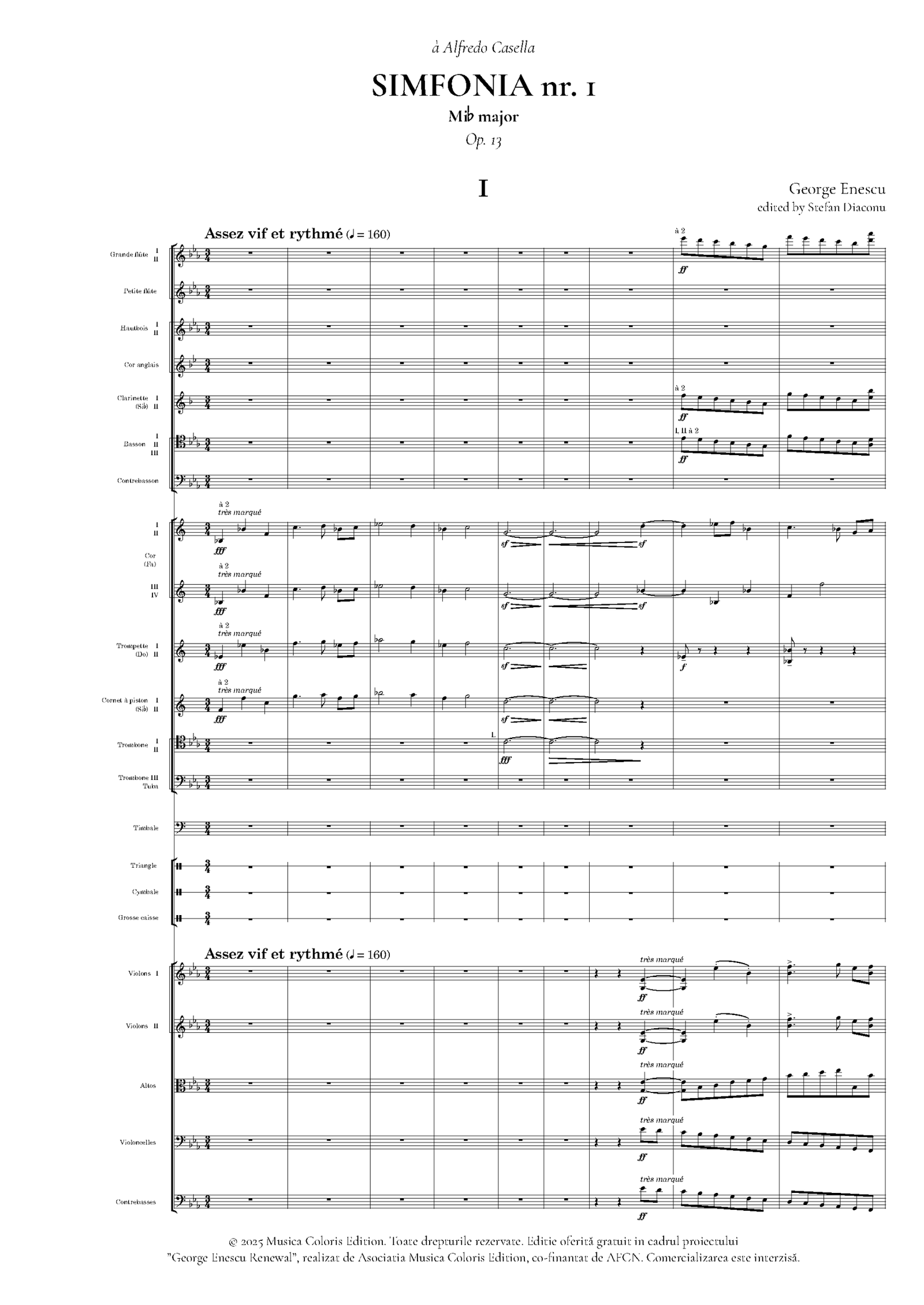
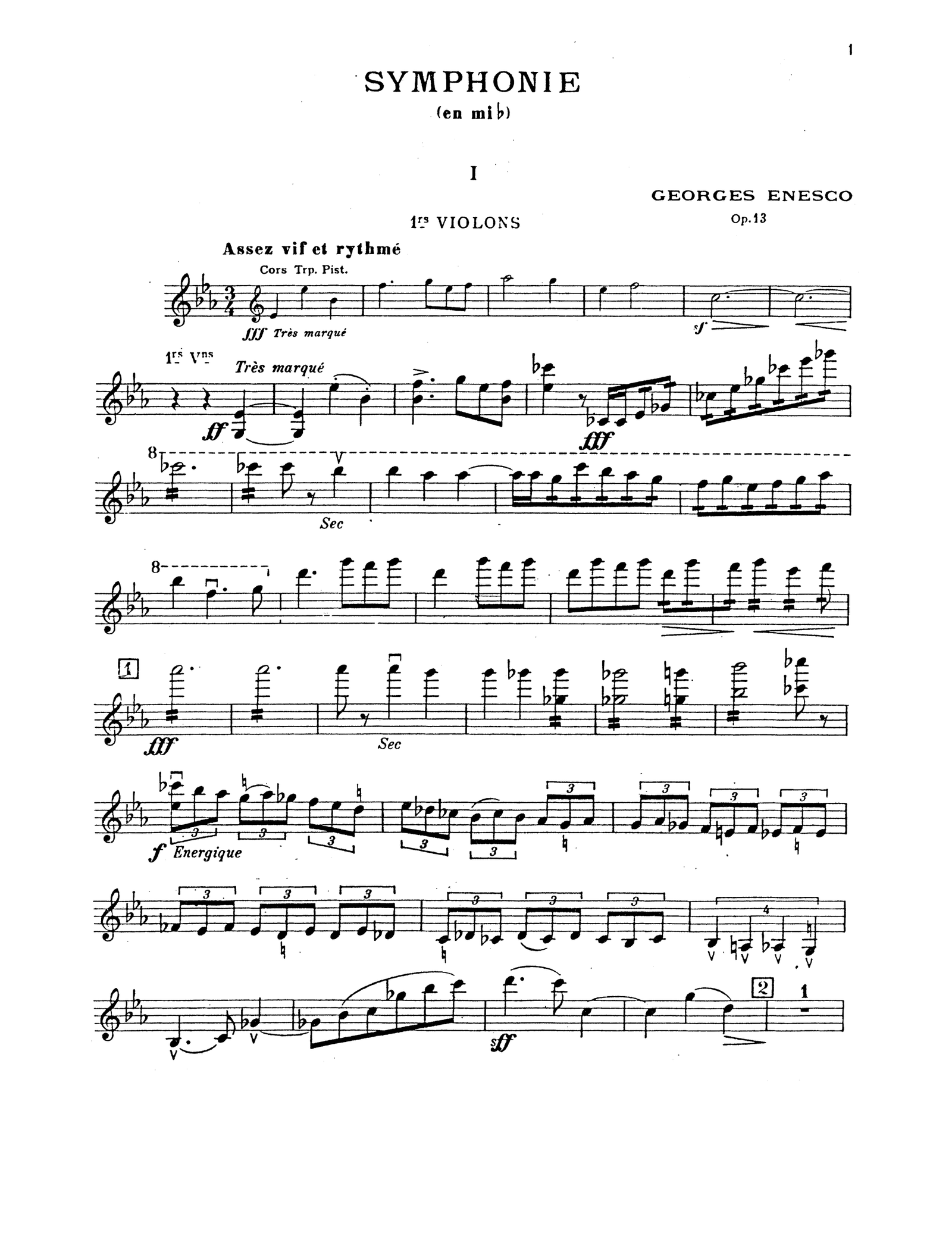
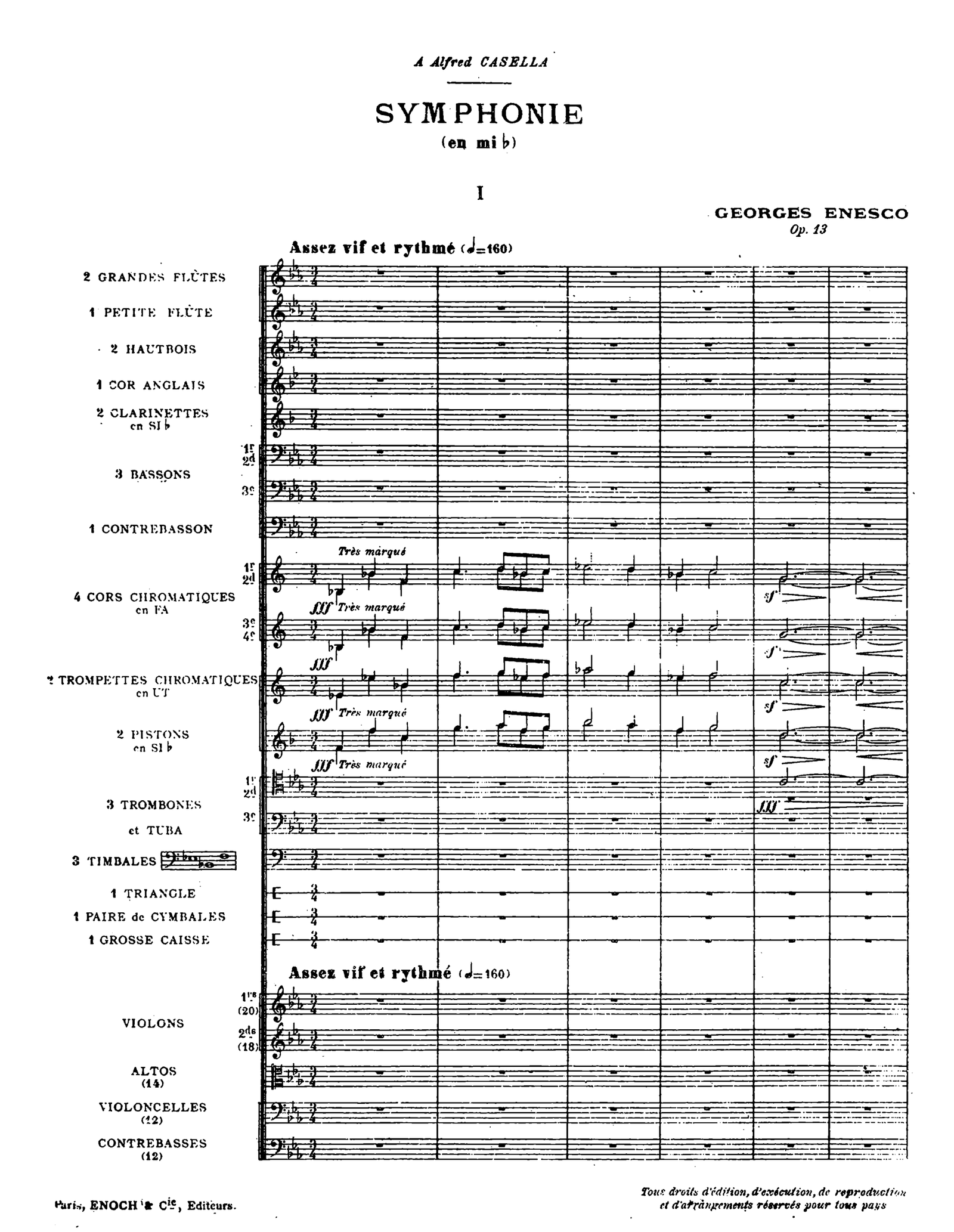
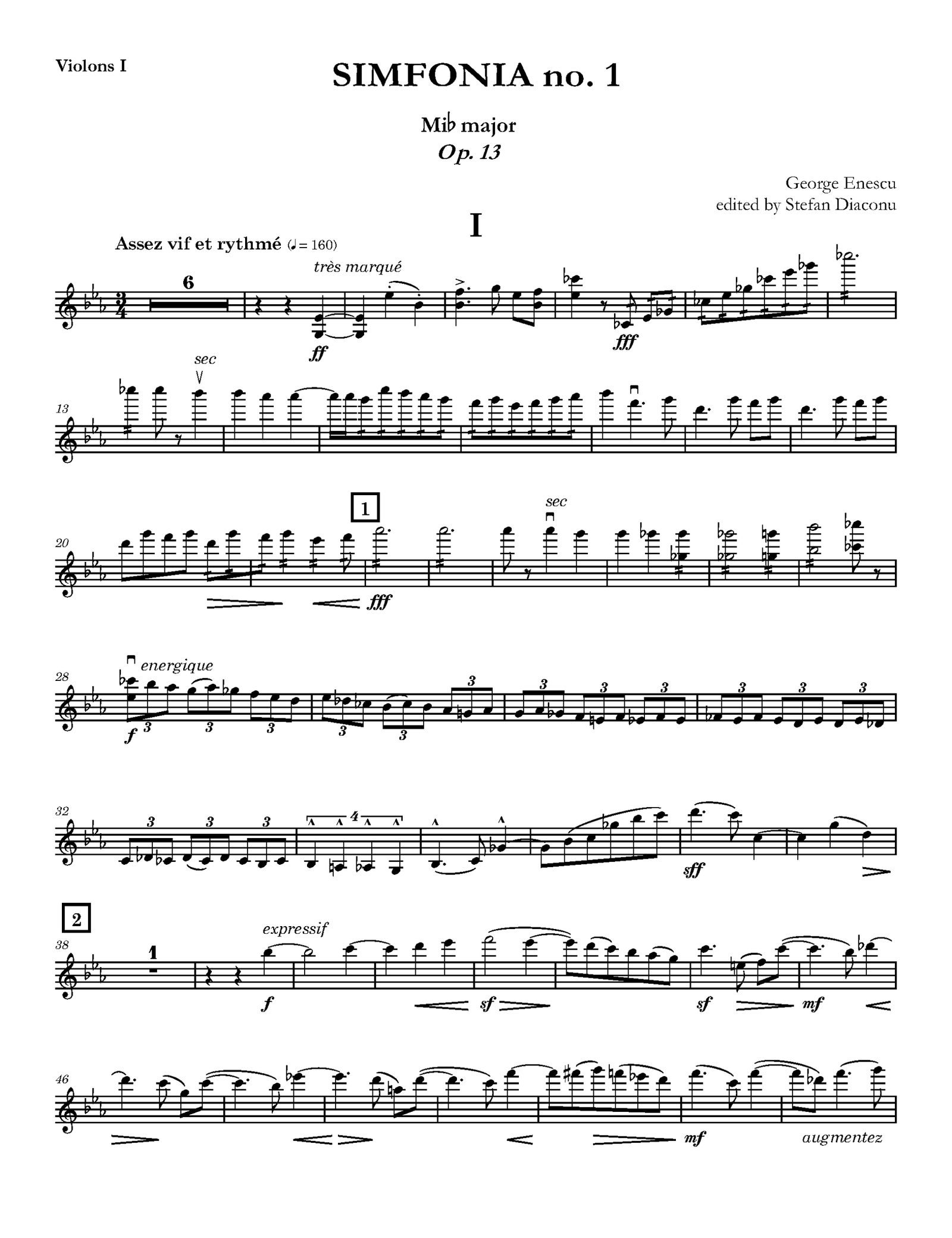
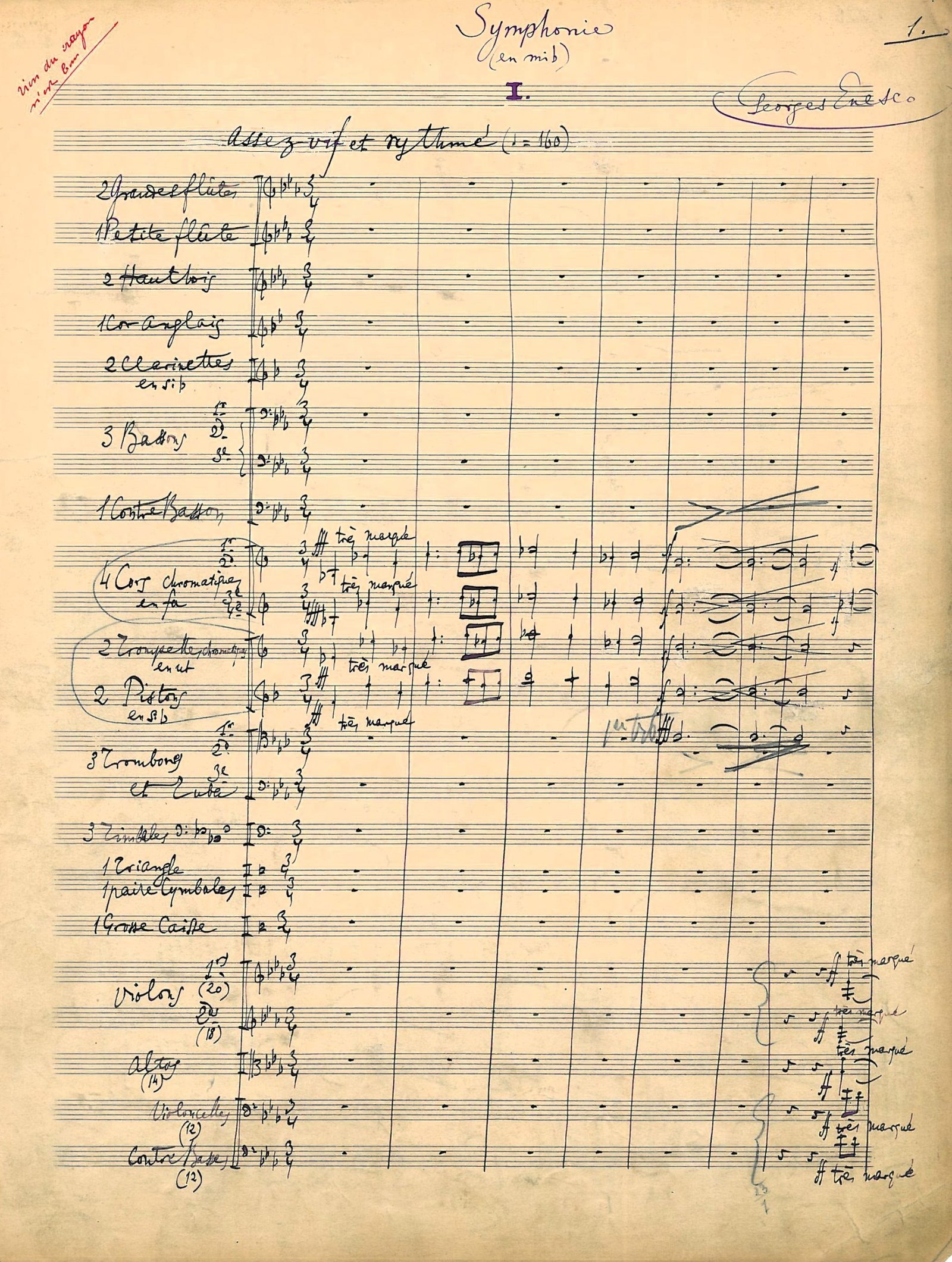
Symphony no. 1, in E-flat major, op. 13
0,00 €
- The first modern Urtext edition, based on the final versions of Enescu’s revised manuscripts, including his handwritten conducting indications, with additional info from the previously published score by Durand & Salabert
- Orchestral parts in a large format (9 × 12 inch) with practical page turns
- Score in large format – B4
- Foreword detailing the origins of the composition, its premiere, and an analysis of the musical material by Vlad Văidean, a musicologist with expertise in the works of George Enescu (English, French, Romanian)
- In accordance with the original score, the expressive and performance technique markings are written in French
- Alternative B-flat Bass clarinet orchestral parts for original transposition: Bass clarinet in A
- Percussion parts reorganised in a clear and easy to perform manner
Explore the score history
In 1905, George Enescu completed his Symphony No. 1 in E-flat major, Op. 13, marking the beginning of his mature compositional phase in the symphonic genre, which he regarded as the most complex and demanding. Although he had already written four symphonies between the ages of 14 and 17, these were considered student works and were not assigned opus numbers. Symphony No. 1, composed over three years, reflects Enescu’s perfectionism and his desire to create enduring works, in contrast to the contemporary trend of rushed compositions. Enthusiastically received and never revised, the symphony stands out for its youthful energy, idealism, and expressive power, serving as a musical proclamation of Enescu’s identity. Its E-flat major tonality, combative discourse, and bold opening theme have drawn comparisons to classical models, but more significantly, the emergence of a distinct idiom would become emblematic of his style and the George Enescu International Festival.
Symphony No. 1, Op. 13 has been extensively analyzed over time and is considered one of Enescu’s most complex and debated works due to the wide range of stylistic influences attributed to it—from Beethoven, Brahms, and Wagner to Mahler and Berlioz. While these influences are evident, they are fully subordinated to a personal voice already well defined, characterized by Mediterranean lyricism, brilliant orchestral color, and a unique variation technique distinct from the Germanic model. The symphony is notable for its consistency, scale, and modernity, and is seen as a creative milestone in Enescu’s career. Its premiere in 1906 in Paris, conducted by Édouard Colonne, was a defining moment for Enescu, and the work later became a staple in international concert repertoires, affirming his status as a European composer of stature, capable of constructing monumental sonic architectures.
Detailed scoring
3 Flutes
(III changing to Piccolo Flute)
2 Oboes
1 English Horn
2 Clarinets in B ♭ & A
1 Bass Clarinet in A
(changing to Piccolo Clarinet in E ♭)
3 Bassoons
1 Contrabassoon
4 Horns in F
2 Trumpets in C
2 Pistons Cornets in B ♭
3 Trombones
1 Tuba
Timpani
Percussion I: Triangle
Percussion II: Cymbals
Percussion III: Tambour de Basque (Tambourine), Bass Drum
2 Harp
Strings: 20-18-14-12-12
In 1905, George Enescu completed his Symphony No. 1 in E-flat major, Op. 13, marking the beginning of his mature compositional phase in the symphonic genre, which he regarded as the most complex and demanding. Although he had already written four symphonies between the ages of 14 and 17, these were considered student works and were not assigned opus numbers. Symphony No. 1, composed over three years, reflects Enescu’s perfectionism and his desire to create enduring works, in contrast to the contemporary trend of rushed compositions. Enthusiastically received and never revised, the symphony stands out for its youthful energy, idealism, and expressive power, serving as a musical proclamation of Enescu’s identity. Its E-flat major tonality, combative discourse, and bold opening theme have drawn comparisons to classical models, but more significantly, the emergence of a distinct idiom would become emblematic of his style and the George Enescu International Festival.
Symphony No. 1, Op. 13 has been extensively analyzed over time and is considered one of Enescu’s most complex and debated works due to the wide range of stylistic influences attributed to it—from Beethoven, Brahms, and Wagner to Mahler and Berlioz. While these influences are evident, they are fully subordinated to a personal voice already well defined, characterized by Mediterranean lyricism, brilliant orchestral color, and a unique variation technique distinct from the Germanic model. The symphony is notable for its consistency, scale, and modernity, and is seen as a creative milestone in Enescu’s career. Its premiere in 1906 in Paris, conducted by Édouard Colonne, was a defining moment for Enescu, and the work later became a staple in international concert repertoires, affirming his status as a European composer of stature, capable of constructing monumental sonic architectures.
3 Flutes
(III changing to Piccolo Flute)
2 Oboes
1 English Horn
2 Clarinets in B ♭ & A
1 Bass Clarinet in A
(changing to Piccolo Clarinet in E ♭)
3 Bassoons
1 Contrabassoon
4 Horns in F
2 Trumpets in C
2 Pistons Cornets in B ♭
3 Trombones
1 Tuba
Timpani
Percussion I: Triangle
Percussion II: Cymbals
Percussion III: Tambour de Basque (Tambourine), Bass Drum
2 Harp
Strings: 20-18-14-12-12
| Title | Symphony no. 1, in E-flat major, op. 13 |
|---|---|
| Editor | Stefan Diaconu |
| Score study | Vlad Văidean |
| Languages of the text | English, French, Romanian |
| Instruments | Bass Clarinet, Bass Drum, Bassoon, Clarinet, Contrabassoon, Cymbals, English Horn, Flute, Harp, Horn, Oboe, Piccolo Clarinet, Piccolo Flute, Pistons Cornets, Strings, Tambour de Basque, Timpani, Triangle, Trombone, Trumpet, Tuba |
| Duration (approx.) | 31 min |
| Number of pages | 141 |
| Page format | B4 |
| Scoring | Symphonic work |
| Score Type | Original Urtext |
| Product format | 01. Full score |
| Publishing Date | 28.10.2025 |
| Publisher | Musica Coloris Edition |
| Edition number | MC1.1.1.23 |
| ISMN | 979-0-807103-03-5 |
| Manufacturer Identification | Editura Musica Coloris, CUI 51641026, Butimanu nr. 545, jud. Dâmbovița, postal code : 137075 |
| Availability | Digital (download) |
| Remark |


