

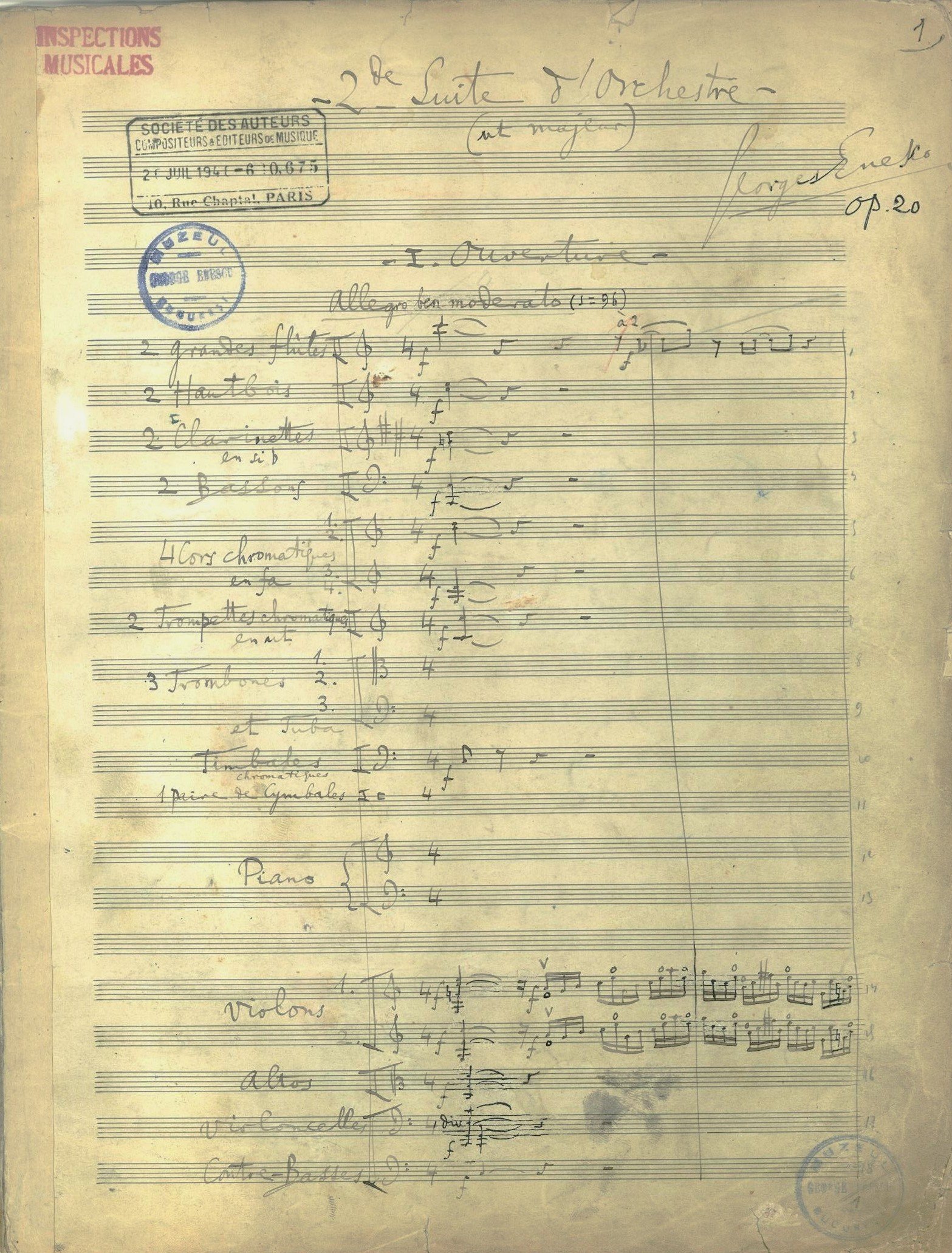
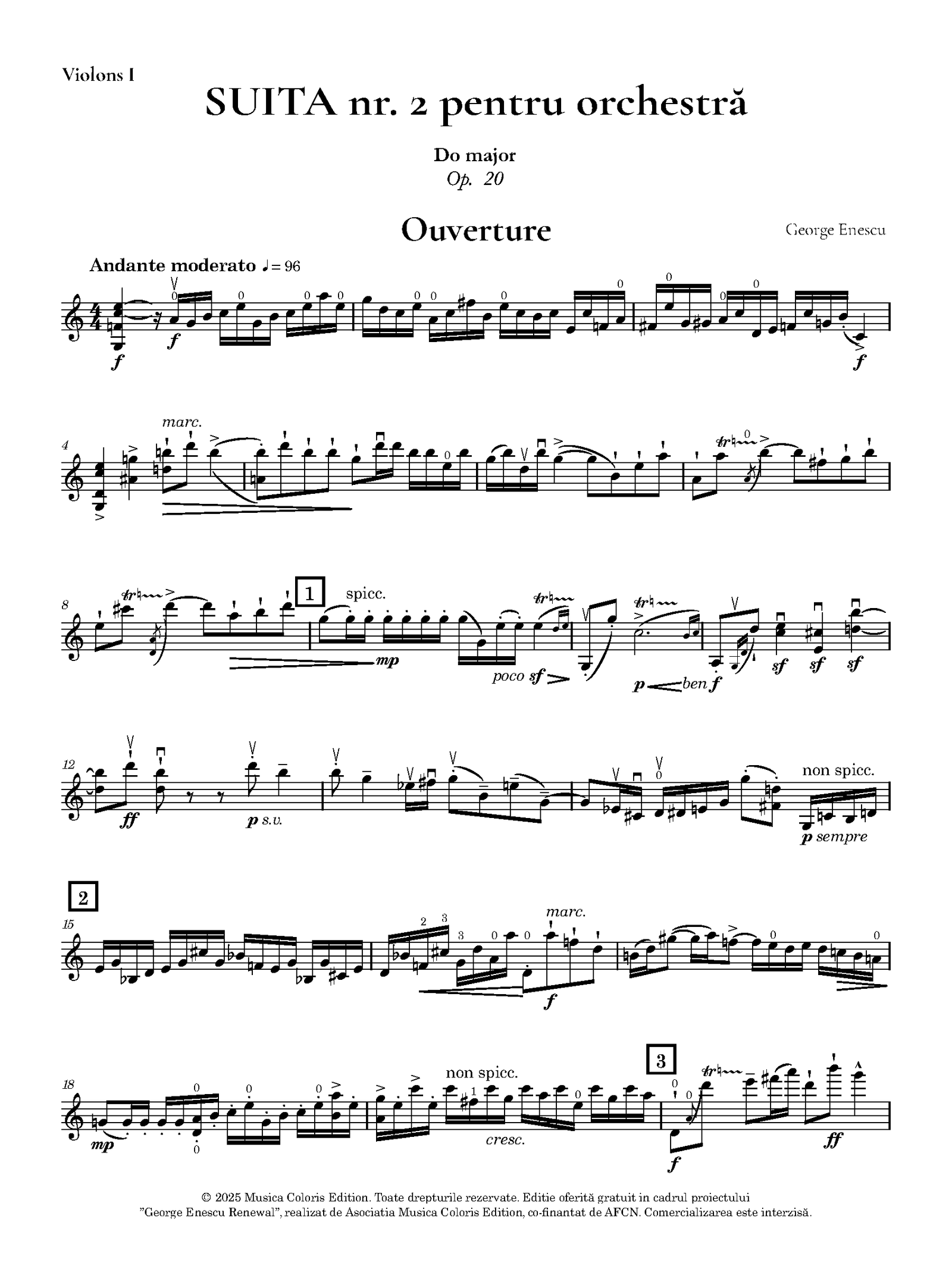
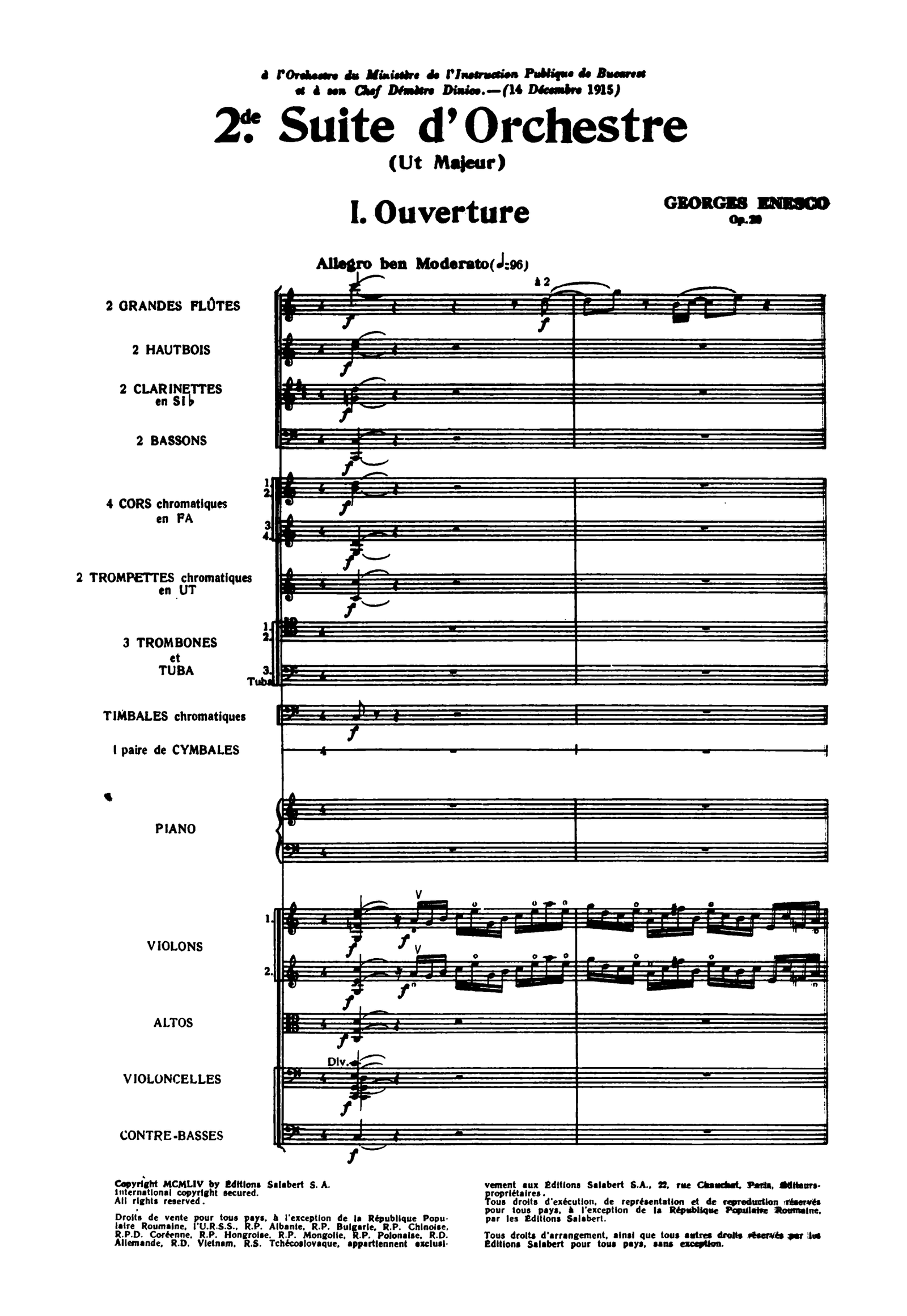
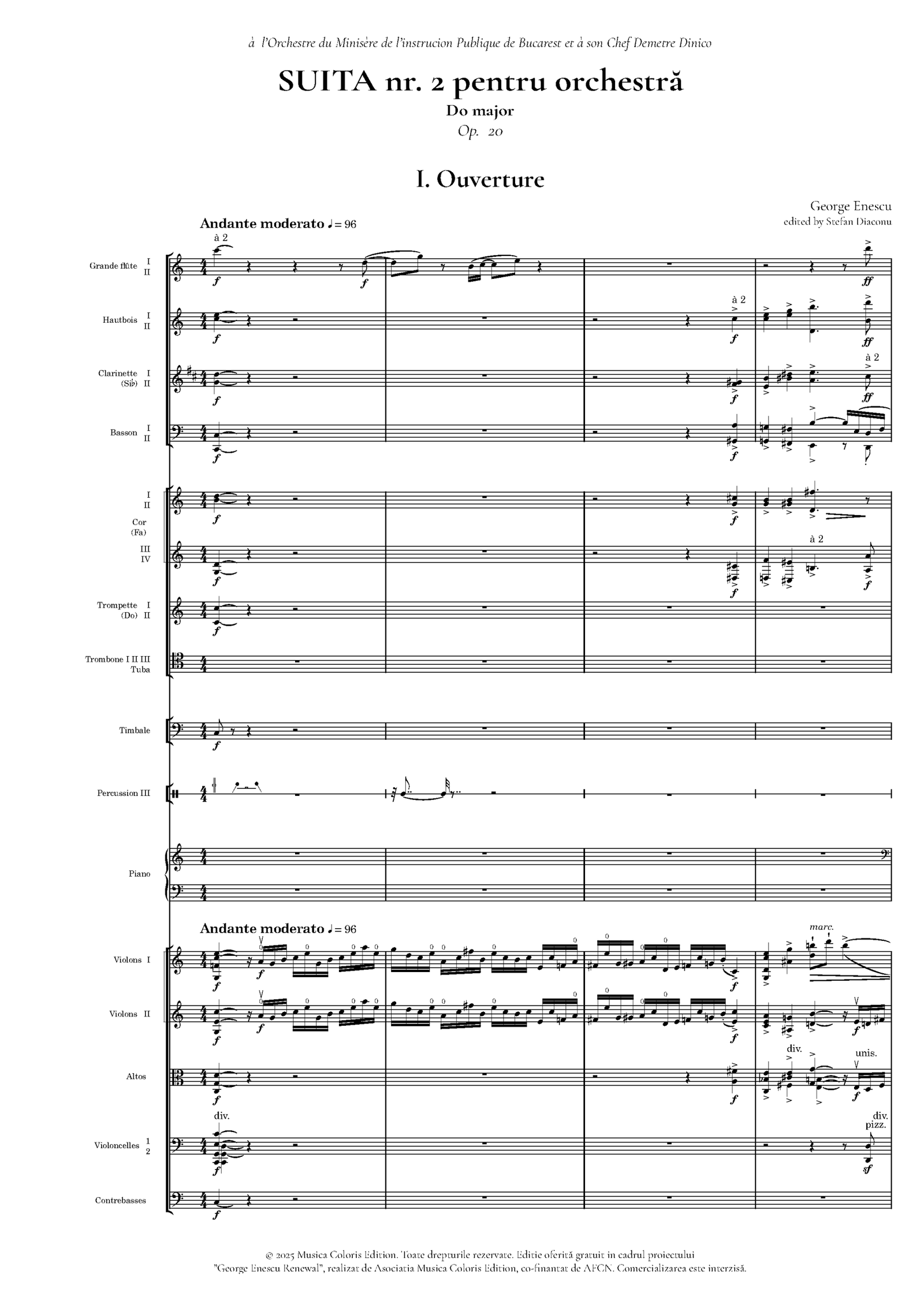
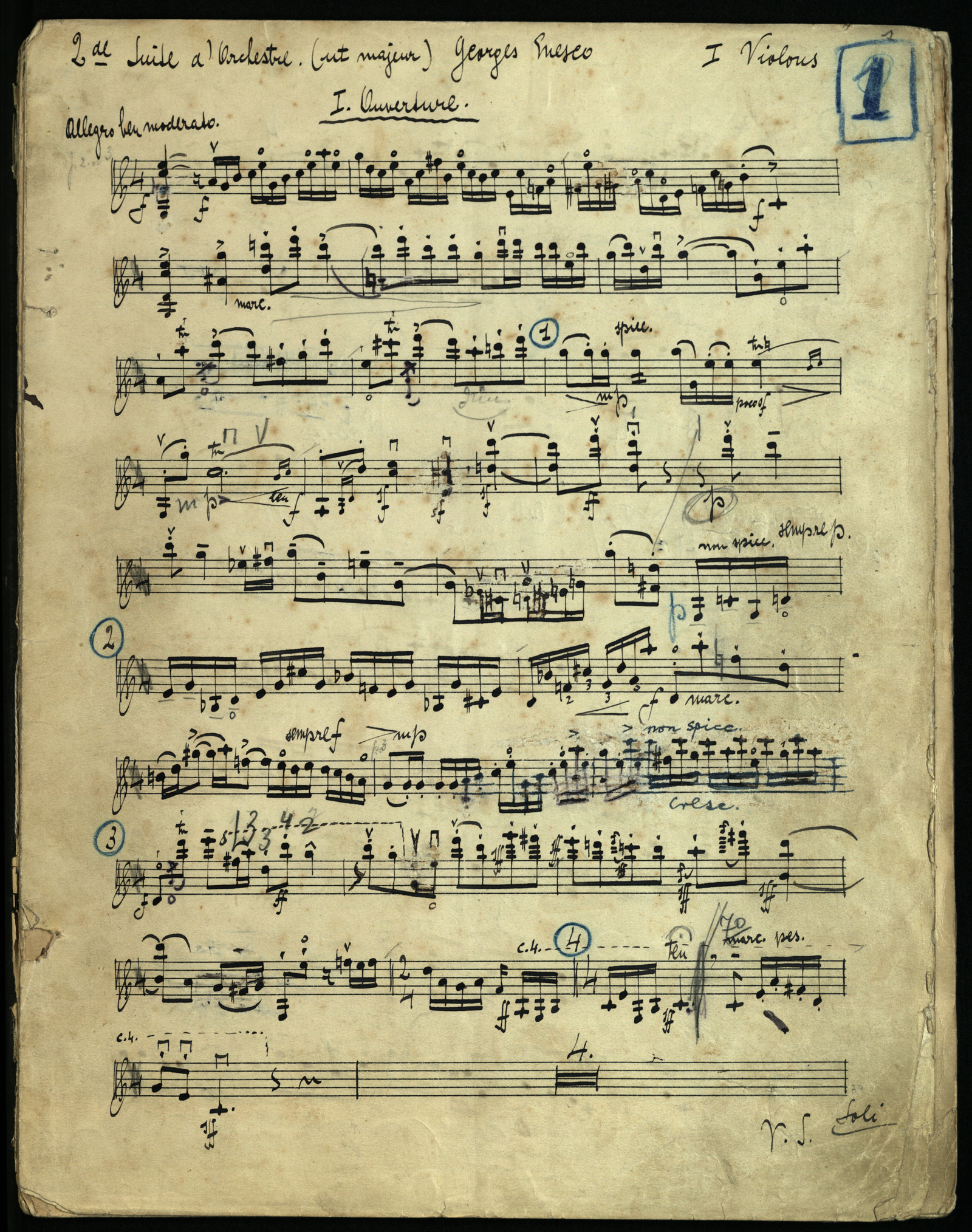
Orchestral Suite no.2, in C major, op. 20
0,00 €
- The first modern Urtext edition, based on the final versions of Enescu’s revised score and parts manuscripts
- Orchestral parts in a large format (9 × 12 inch) with practical page turns
- Score in large format – A3
- Foreword detailing the origins of the composition, its premiere, and an analysis of the musical material by Vlad Văidean, a musicologist with expertise in the works of George Enescu (English, French, Romanian)
- Percussion parts reorganised in a clear and easy to perform manner
Explore the score history
Composed swiftly between August and December 1915 and premiered on March 27, 1916, at the Romanian Athenaeum in Bucharest under Enescu’s baton, the Suite No. 2 in C major, Op. 20, stands as an early and outstanding contribution to the neoclassical movement, predating iconic works like Prokofiev’s Classical Symphony or Ravel’s Tombeau de Couperin. However, it did not receive immediate international recognition due to its manuscript being sent for safekeeping during the war and only recovered in 1925. During the interwar period, Enescu frequently conducted the suite, which should be seen not merely as a product of an established aesthetic, but as a major achievement at the dawn of neoclassicism. The suite explores “classicism” as a living principle rather than a stylistic exercise, leaning toward neo-Baroque through a modern reimagining of Baroque dance forms, with masterful polyphonic technique and generous orchestration, devoid of irony and infused with Enescu’s unmistakable lyrical warmth.
The suite’s structure follows a palindromic symmetry: the outer movements (Overture and Bourrée) focus on polyphonic energy, the intermediate ones (Sarabande and Air) on melodic-harmonic lyricism, and the central ones (Gigue and Menuet grave) act as complementary rhythmic segments. Enescu employs recurring motifs, such as the descending cell do-si-sol, to create latent cyclic connections. The Overture features a sophisticated double fugue, while the Sarabande introduces doina-like inflections, further developed in the Air, where the melody reaches romantic fullness. The airy Gigue and the weighty Menuet subtly undermine traditional dance patterns through polyrhythms and asymmetries, and the final Bourrée culminates in a symphonic recap, with thematic material evolving internally and concluding in a jubilant polyphonic climax that unifies the suite’s energies.
Detailed scoring
3 Flutes
(III changing to Piccolo Flute)
2 Oboes
1 English Horn
2 Clarinets in B ♭
2 Bassoons
4 Horns in F
2 Trumpets in C
3 Trombones
1 Tuba
Timpani
Percussion I: Triangle, Castanets, Tam-tam
Percussion II: Tambour de Basque (Tambourine), Drum
Percussion III: Cymbals, Bass Drum, Glockenspiel
Piano
Harp
Strings: 20-18-14-12-12
Composed swiftly between August and December 1915 and premiered on March 27, 1916, at the Romanian Athenaeum in Bucharest under Enescu’s baton, the Suite No. 2 in C major, Op. 20, stands as an early and outstanding contribution to the neoclassical movement, predating iconic works like Prokofiev’s Classical Symphony or Ravel’s Tombeau de Couperin. However, it did not receive immediate international recognition due to its manuscript being sent for safekeeping during the war and only recovered in 1925. During the interwar period, Enescu frequently conducted the suite, which should be seen not merely as a product of an established aesthetic, but as a major achievement at the dawn of neoclassicism. The suite explores “classicism” as a living principle rather than a stylistic exercise, leaning toward neo-Baroque through a modern reimagining of Baroque dance forms, with masterful polyphonic technique and generous orchestration, devoid of irony and infused with Enescu’s unmistakable lyrical warmth.
The suite’s structure follows a palindromic symmetry: the outer movements (Overture and Bourrée) focus on polyphonic energy, the intermediate ones (Sarabande and Air) on melodic-harmonic lyricism, and the central ones (Gigue and Menuet grave) act as complementary rhythmic segments. Enescu employs recurring motifs, such as the descending cell do-si-sol, to create latent cyclic connections. The Overture features a sophisticated double fugue, while the Sarabande introduces doina-like inflections, further developed in the Air, where the melody reaches romantic fullness. The airy Gigue and the weighty Menuet subtly undermine traditional dance patterns through polyrhythms and asymmetries, and the final Bourrée culminates in a symphonic recap, with thematic material evolving internally and concluding in a jubilant polyphonic climax that unifies the suite’s energies.
3 Flutes
(III changing to Piccolo Flute)
2 Oboes
1 English Horn
2 Clarinets in B ♭
2 Bassoons
4 Horns in F
2 Trumpets in C
3 Trombones
1 Tuba
Timpani
Percussion I: Triangle, Castanets, Tam-tam
Percussion II: Tambour de Basque (Tambourine), Drum
Percussion III: Cymbals, Bass Drum, Glockenspiel
Piano
Harp
Strings: 20-18-14-12-12
| Title | Orchestral Suite no.2, in C major, op. 20 |
|---|---|
| Editor | Stefan Diaconu |
| Score study | Vlad Văidean |
| Languages of the text | English, French, Romanian |
| Instruments | Bass Drum, Bassoon, Castanets, Clarinet, Cymbals, Drum, English Horn, Flute, Glockenspiel, Harp, Horn, Oboe, Piano, Piccolo Flute, Strings, Tam-tam, Tambour de Basque, Timpani, Triangle, Trombone, Trumpet, Tuba |
| Duration (approx.) | 45 min |
| Number of pages | 113 |
| Page format | B4 |
| Scoring | Symphonic work |
| Score Type | Original Urtext |
| Product format | 01. Full score |
| Publishing Date | 28.10.2025 |
| Publisher | Musica Coloris Edition |
| Edition number | MC1.1.1.23 |
| ISMN | 979-0-807103-07-3 |
| Manufacturer Identification | Editura Musica Coloris, CUI 51641026, Butimanu nr. 545, jud. Dâmbovița, postal code : 137075 |
| Availability | Digital (download) |
| Remark |


