

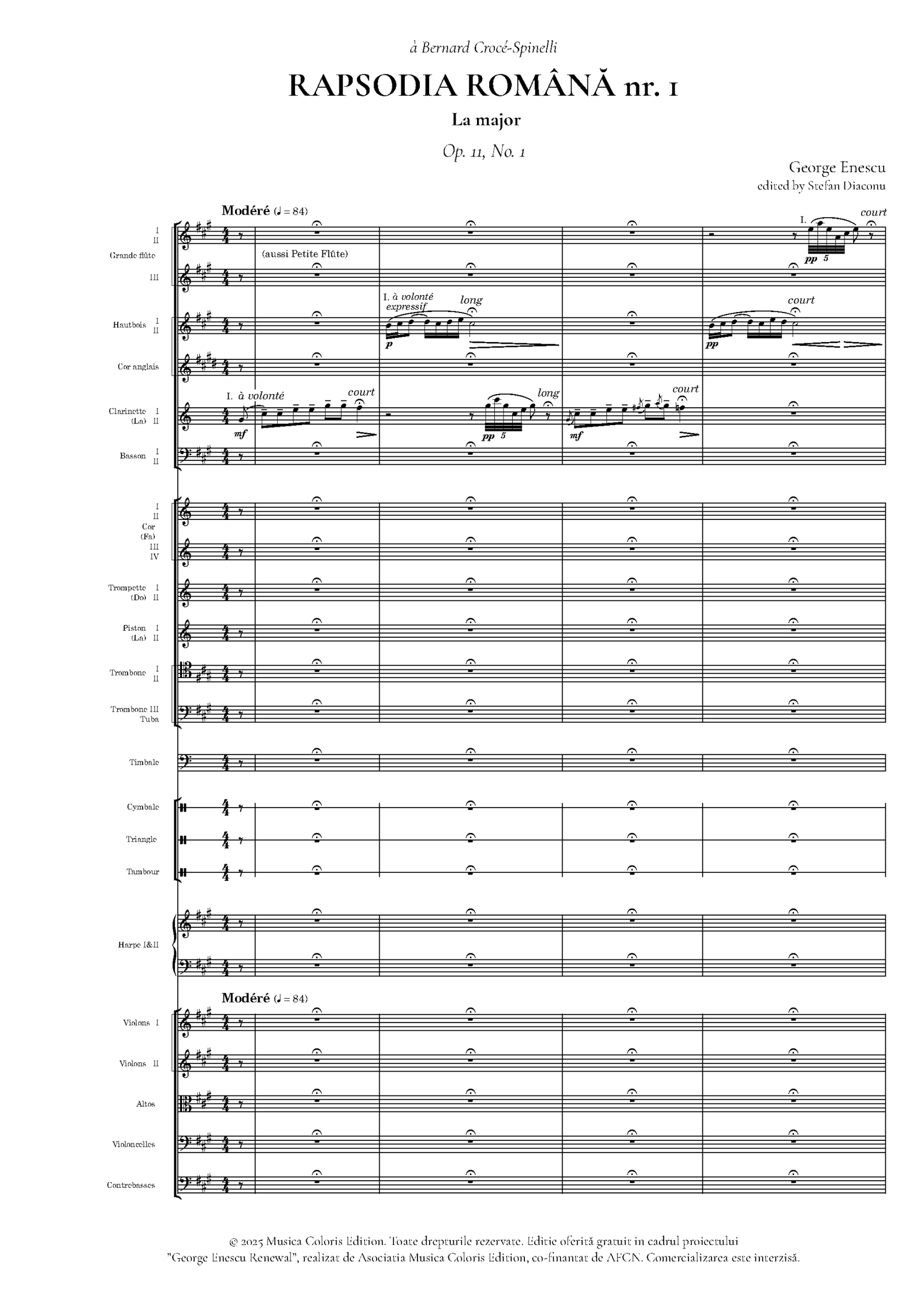
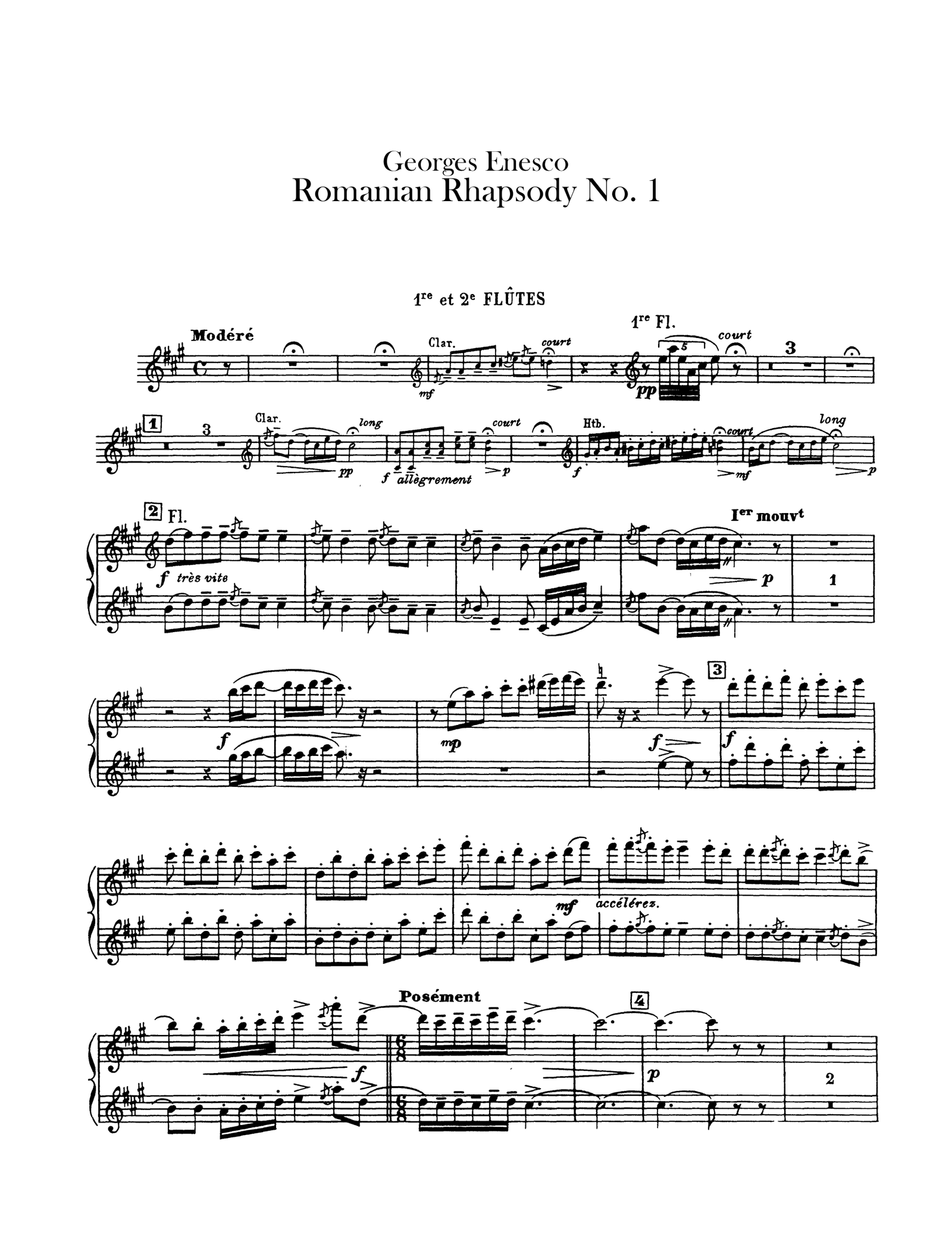
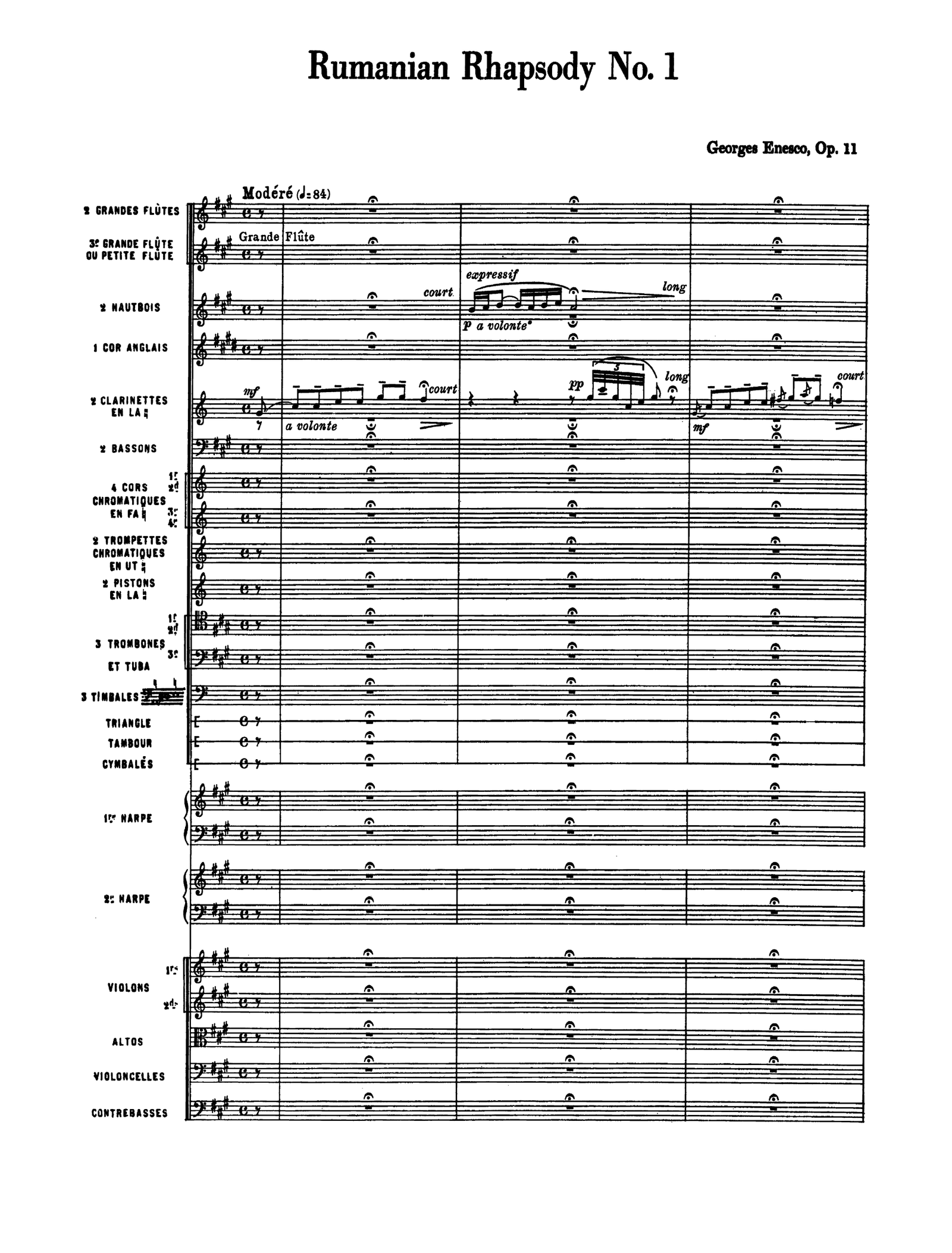
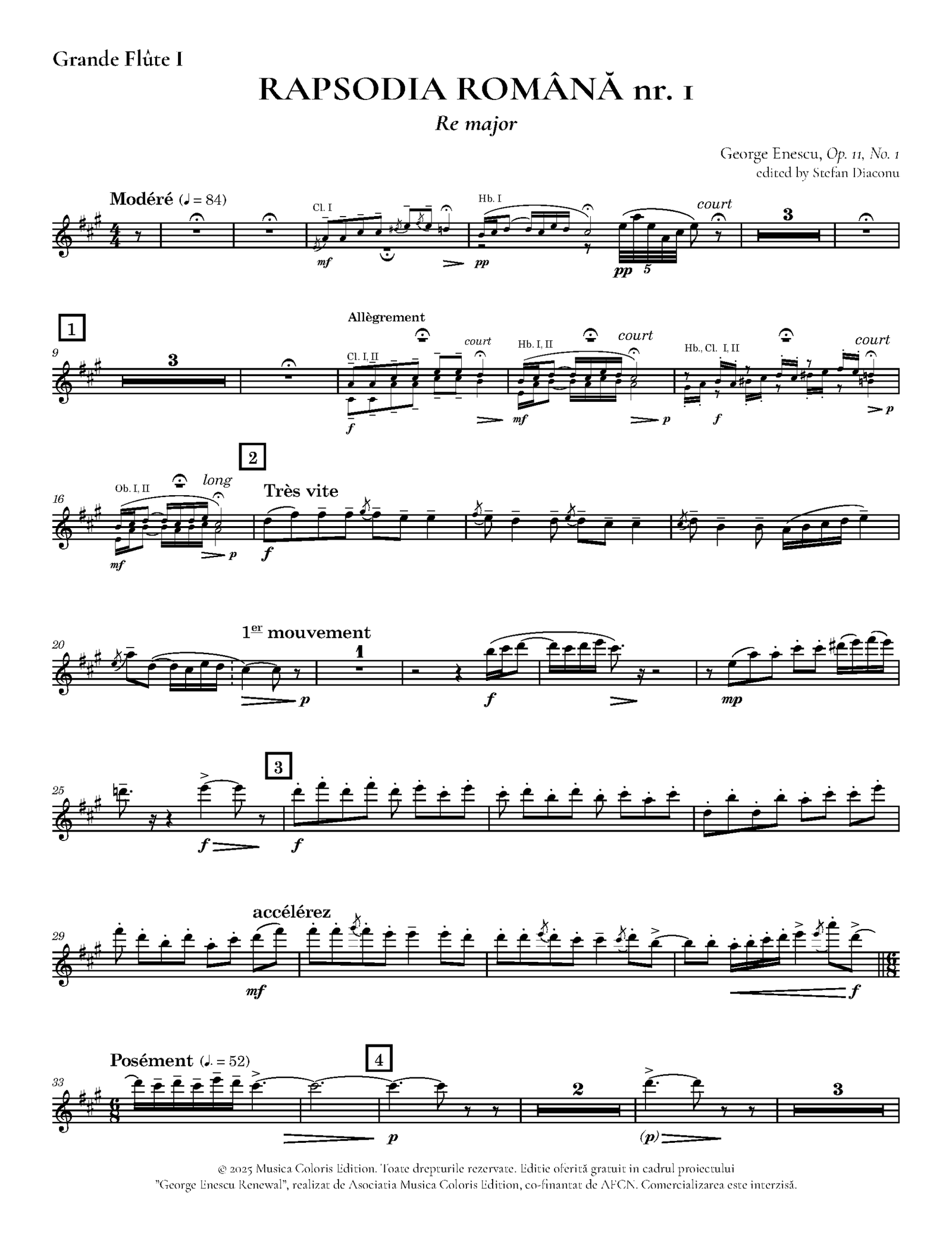
Romanian Rhapsody no. 1, in A major, op. 11, no. 1
0,00 €
- The first modern Urtext edition, derived from the previously published score by Durand & Salabert, with all errors from the earlier edition carefully corrected
- Orchestral parts in a large format (9 × 12 inch) with practical page turns
- Score in large format – B4
- Foreword detailing the origins of the composition, its premiere, and an analysis of the musical material by Vlad Văidean, a musicologist with expertise in the works of George Enescu.(English, French, Romanian)
- In accordance with the original score, the expressive and performance technique markings are written in French.
Explore the score history
Despite the immense popularity enjoyed by Romanian Rhapsody No. 1 in A major, George Enescu did not view this notoriety as a source of pride, but rather as an artistic burden. In a letter from 1950, he confessed that he was “fed up to the neck” with the two rhapsodies, especially the first, and would only perform them again for “a major commercial deal.” Although his later works—more refined and introspective—were long overshadowed by the fame of these youthful, uncomplicated pieces, the growing prestige of the “George Enescu” Festival has helped restore balance. Today, audiences can appreciate the two rhapsodies for what they truly are: sparkling romantic expressions of a young genius’s boundless love for his homeland and its music.
Composed in 1901 and premiered in 1903, the first rhapsody quickly became a global symphonic hit and a musical emblem of Romanian identity. It has been used in various contexts—from dissident broadcasts by Radio Free Europe and communist propaganda, to the ringtone summoning Romanian deputies to Parliament and a nostalgic anthem for Romanians abroad. Remarkably, despite its overexposure, the piece retains a freshness and impact thanks to its vibrant rhythm and hypnotic orchestration. Though Enescu claimed he wrote the rhapsodies “purely instinctively,” a closer analysis reveals meticulous care in selecting, arranging, and orchestrating 14 folk melodies, many from urban lăutar traditions. Tunes like “I’ve got a coin and I want to drink,” “Ciocârlia,” and “Hora morii” are woven into a dazzling musical tapestry, culminating in what Pascal Bentoiu vividly described as “the feeling of an endless celebration,” a euphoric state akin to the one following a second glass of champagne.
Detailed scoring
3 Flutes
(III changing to Piccolo Flute)
2 Oboes
1 English Horn
2 Clarinets in A
2 Bassoons
4 Horns in F
2 Trumpets in C
2 Pistons Cornets in A
3 Trombones
1 Tuba
Timpani
Percussion I: Triangle
Percussion II: Drum
Percussion III: Cymbals
2 Harps
Strings: 20-18-14-12-12
Despite the immense popularity enjoyed by Romanian Rhapsody No. 1 in A major, George Enescu did not view this notoriety as a source of pride, but rather as an artistic burden. In a letter from 1950, he confessed that he was “fed up to the neck” with the two rhapsodies, especially the first, and would only perform them again for “a major commercial deal.” Although his later works—more refined and introspective—were long overshadowed by the fame of these youthful, uncomplicated pieces, the growing prestige of the “George Enescu” Festival has helped restore balance. Today, audiences can appreciate the two rhapsodies for what they truly are: sparkling romantic expressions of a young genius’s boundless love for his homeland and its music.
Composed in 1901 and premiered in 1903, the first rhapsody quickly became a global symphonic hit and a musical emblem of Romanian identity. It has been used in various contexts—from dissident broadcasts by Radio Free Europe and communist propaganda, to the ringtone summoning Romanian deputies to Parliament and a nostalgic anthem for Romanians abroad. Remarkably, despite its overexposure, the piece retains a freshness and impact thanks to its vibrant rhythm and hypnotic orchestration. Though Enescu claimed he wrote the rhapsodies “purely instinctively,” a closer analysis reveals meticulous care in selecting, arranging, and orchestrating 14 folk melodies, many from urban lăutar traditions. Tunes like “I’ve got a coin and I want to drink,” “Ciocârlia,” and “Hora morii” are woven into a dazzling musical tapestry, culminating in what Pascal Bentoiu vividly described as “the feeling of an endless celebration,” a euphoric state akin to the one following a second glass of champagne.
3 Flutes
(III changing to Piccolo Flute)
2 Oboes
1 English Horn
2 Clarinets in A
2 Bassoons
4 Horns in F
2 Trumpets in C
2 Pistons Cornets in A
3 Trombones
1 Tuba
Timpani
Percussion I: Triangle
Percussion II: Drum
Percussion III: Cymbals
2 Harps
Strings: 20-18-14-12-12
| Title | Romanian Rhapsody no. 1, in A major, op. 11, no. 1 |
|---|---|
| Editor | Stefan Diaconu |
| Score study | Vlad Văidean |
| Languages of the text | English, French, Romanian |
| Instruments | Bassoon, Clarinet, Cymbals, Drum, English Horn, Flute, Harp, Horn, Oboe, Piccolo Flute, Pistons Cornets, Strings, Timpani, Triangle, Trombone, Trumpet, Tuba |
| Duration (approx.) | 12 min |
| Number of pages | 95 |
| Page format | B4 |
| Scoring | Symphonic work |
| Score Type | Original Urtext |
| Product format | 01. Full score |
| Publishing Date | 28.10.2025 |
| Publisher | Musica Coloris Edition |
| Edition number | MC1.1.1.23 |
| ISMN | 979-0-807103-00-4 |
| Manufacturer Identification | Editura Musica Coloris, CUI 51641026, Butimanu nr. 545, jud. Dâmbovița, postal code : 137075 |
| Availability | Digital (download) |
| Remark |


