

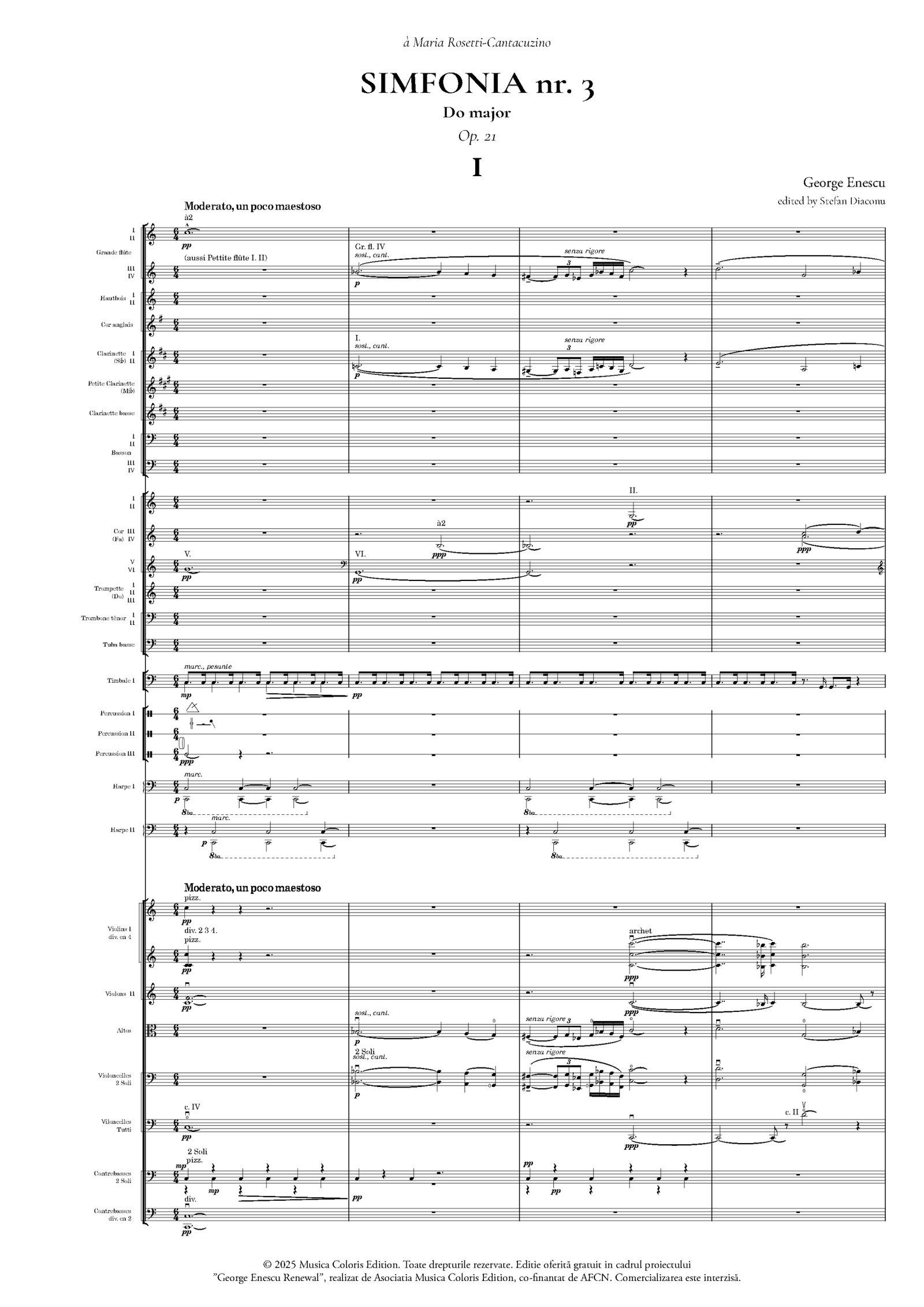
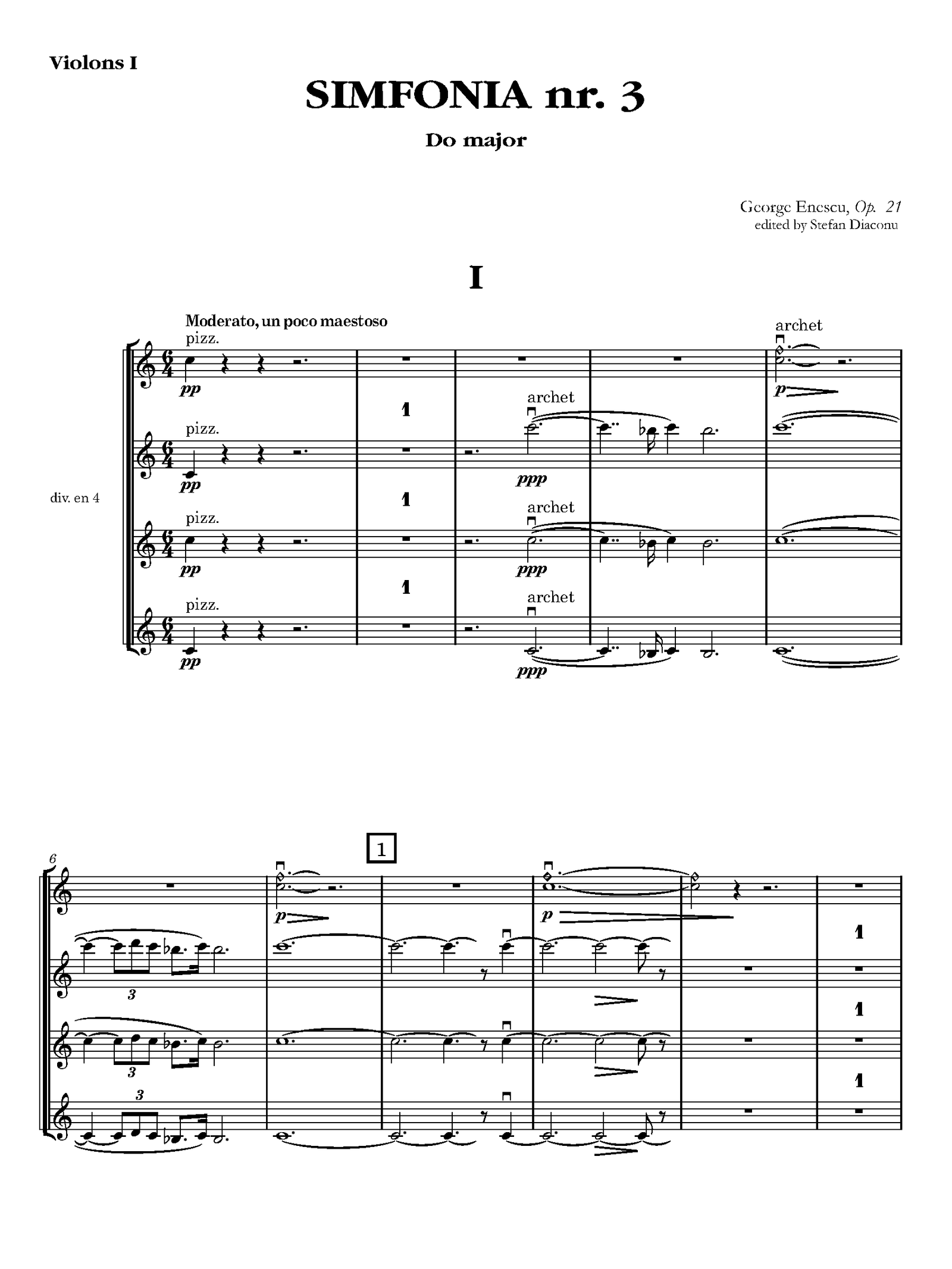
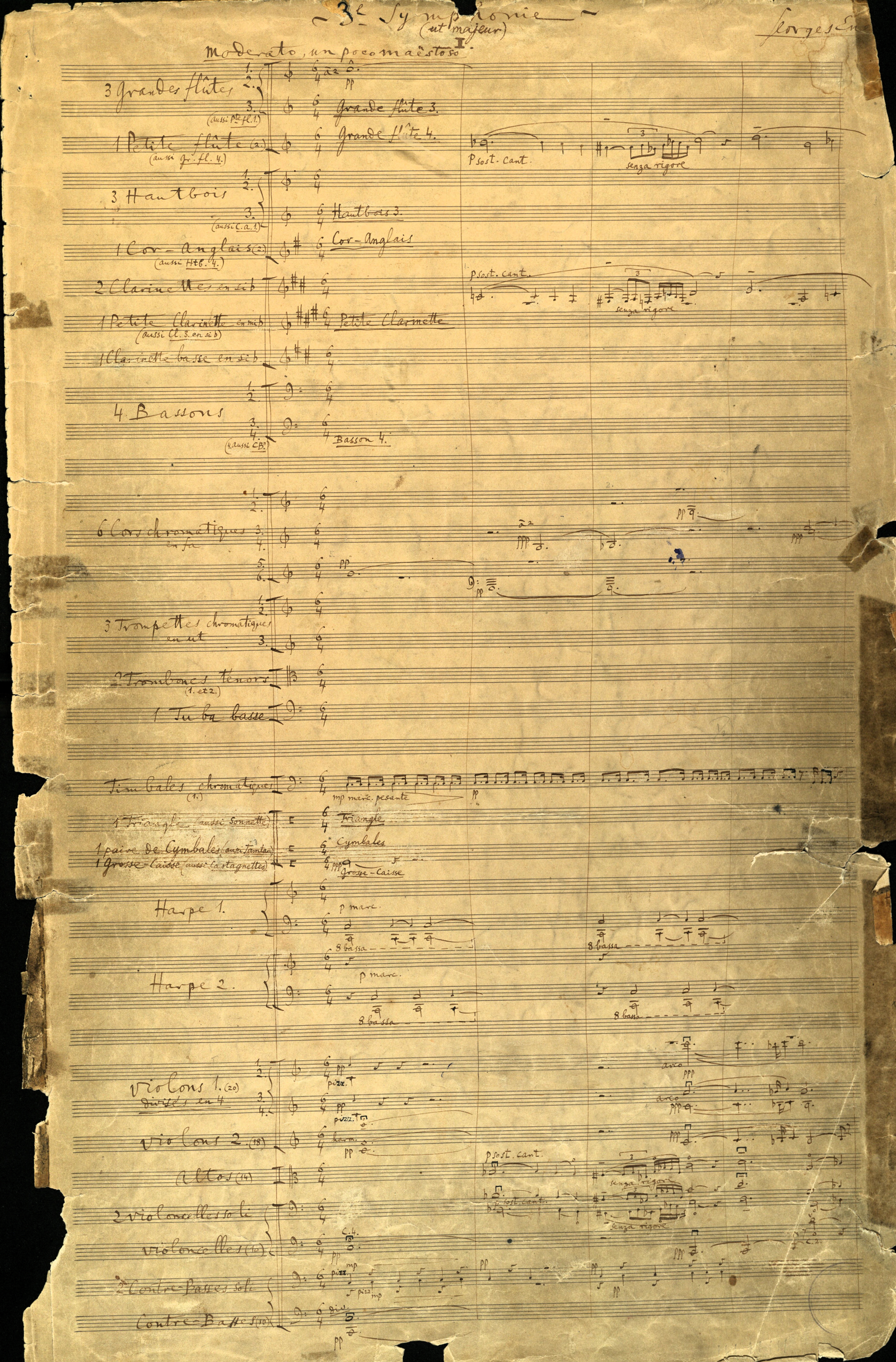
Symphony no. 3, in C major, op. 21
0,00 €
- The first modern Urtext edition, based on the final versions of Enescu’s revised manuscripts, including his handwritten conducting indications
- Orchestral parts in a large format (9 × 12 inch) with practical page turns
- Score in large format – A3
- Foreword detailing the origins of the composition, its premiere, and an analysis of the musical material by Vlad Văidean, a musicologist with expertise in the works of George Enescu (English, French, Romanian)
- Alternative orchestral parts for Tuba in B-flat and F
- Percussion parts reorganised in a clear and easy to perform manner
- Stand-alone off-stage parts
- Vocal score with piano reduction and instrumental cues
- Editorial suggestions for out-of-range passages in Trumpet and Trombone voice
- Playing directions in French and English
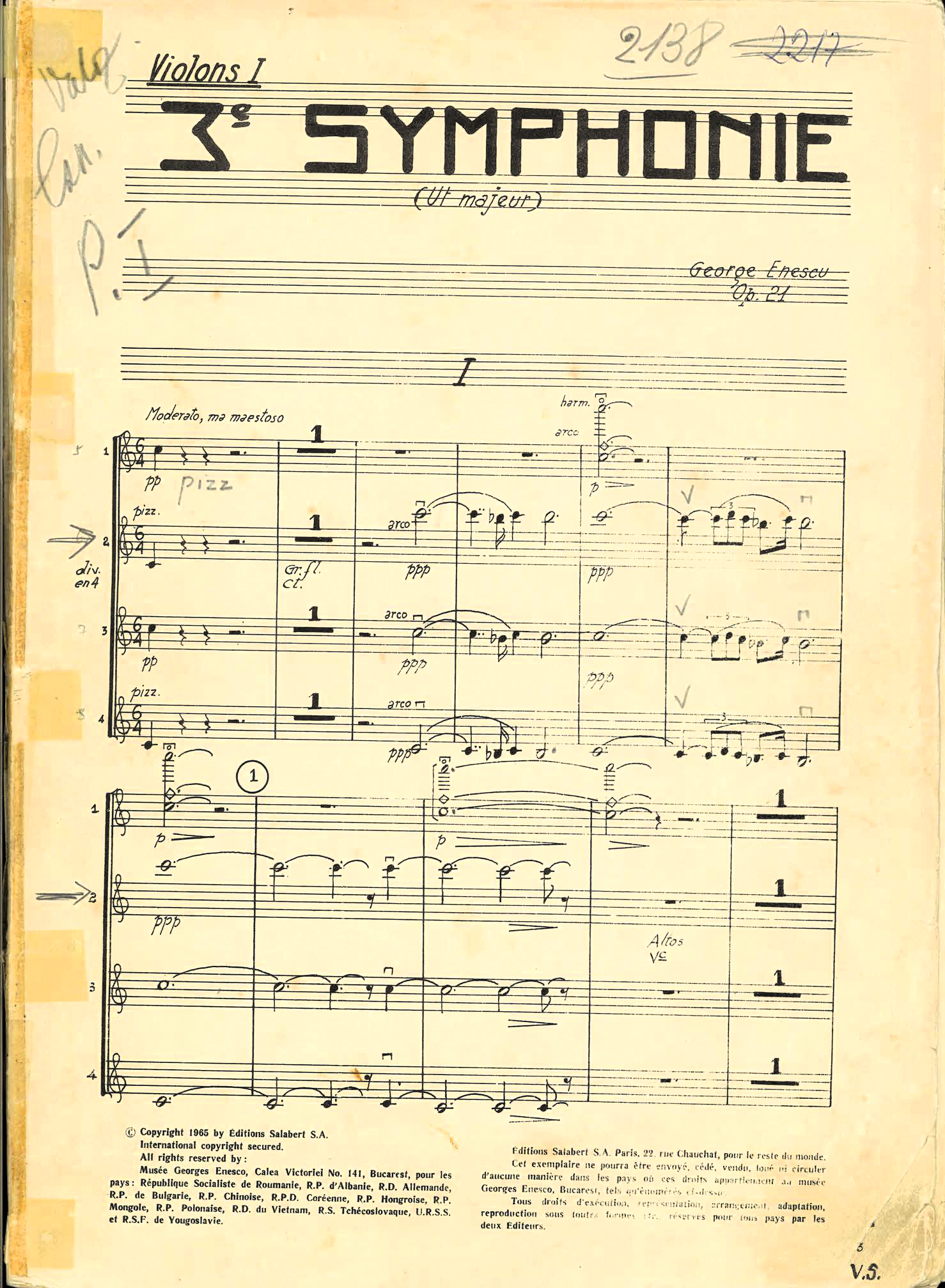
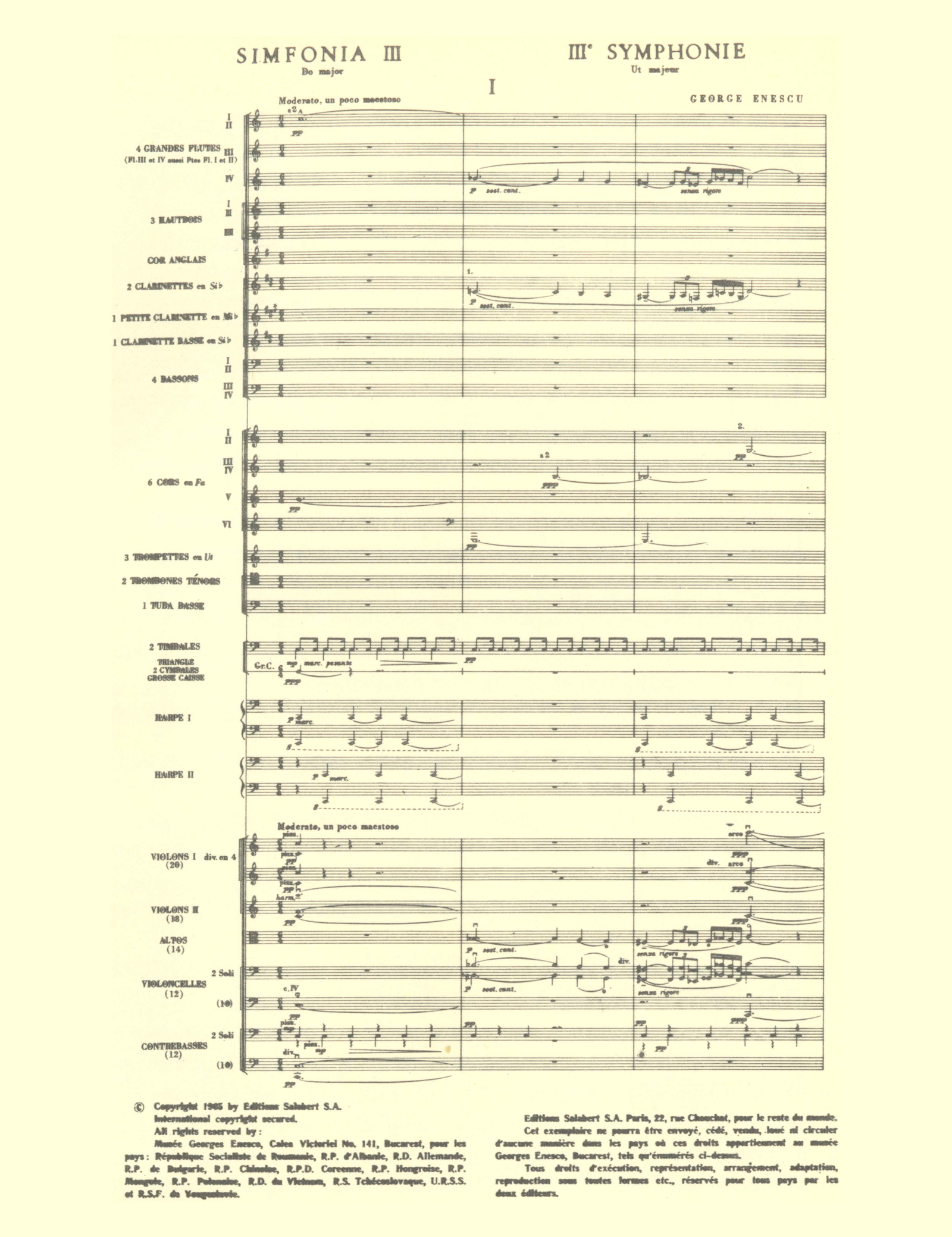
Explore the score history
Symphony No. 3 in C major, Op. 21, was completed by George Enescu in March 1916, during a time marked by war and intense artistic activity in Romania. After interrupting his international career, Enescu devoted himself wholeheartedly to Romanian musical life, performing numerous concerts and premieres, including his own compositions. During his refuge in Moldova, he founded a symphony orchestra in Iași, playing a decisive role in the development of the local musical scene. Upon returning to Bucharest, he conducted nine concerts between March and June 1919, culminating in the premiere of Symphony No. 3, considered a pinnacle of his creative output and of European symphonism in the first half of the 20th century. Revived in 1921 and 1942, the work was received with profound emotion, reflecting the turmoil and hopes of the era in which it was conceived.
Symphony No. 3 has been interpreted by many as having an extramusical dimension, evoking a spiritual journey inspired by Dante’s triptych: from a terrestrial “purgatory” full of contrasts, through a brutal sonic “inferno,” to a paradisiacal, calm, and luminous apotheosis. Enescu reconfigures earlier musical ideas into a finale that suggests the regeneration of the world through purification and essentialization. The choir’s interventions, though wordless, add a religious dimension, culminating in the sound of a bell reminiscent of those used in Catholic liturgy. In this finale, Enescu abandons traditional triumphalism, opting instead for a delicate, mystical apotheosis in which music becomes a spiritual response to human suffering—a noble hope in the soul’s ability to reveal goodness.
Detailed scoring
4 Flutes
(III, IV changing to Piccolo Flutes I, II)
4 Oboes
(III, IV changing to English Horn I, II)
3 Clarinets in B ♭
(III changing to Piccolo Clarinet in E ♭)
1 Clarinet Bass in B ♭
4 Bassoons
(IV changing to Contrabassoon)
6 Horns in F
1 Piccolo Trumpet in D
3 Trumpets in C
2 Cornets in B ♭
1 Pistons Trombone
3 Tenor Trombones
1 Bass Trombone
3 Tubas
(I = Tenor in B ♭/Euphonium, II = Bass in F, III= Contrabass)
2 Timpani Sets (2 players)
Percussion I: Triangle, Rattle, Sonette
Percussion II: Cymbals, Tam-tam
Percussion III: Drum, Tambour de Basque (tambourine)
Percussion IV: Bass Drum, Castanets
Percussion V: Xylophone, Bell sounding F♯1, Thunder Machine
Glockenspiel3 and Celesta (1 player)
Piano (2nd, 3rd mov.)
Organ (or Harmonium) (3rd mov.)
CHOIR
(Sporano, Contra-alto, Tenors, Bass)
2 Harpes
Strings: 20-18-14-12-12
Symphony No. 3 in C major, Op. 21, was completed by George Enescu in March 1916, during a time marked by war and intense artistic activity in Romania. After interrupting his international career, Enescu devoted himself wholeheartedly to Romanian musical life, performing numerous concerts and premieres, including his own compositions. During his refuge in Moldova, he founded a symphony orchestra in Iași, playing a decisive role in the development of the local musical scene. Upon returning to Bucharest, he conducted nine concerts between March and June 1919, culminating in the premiere of Symphony No. 3, considered a pinnacle of his creative output and of European symphonism in the first half of the 20th century. Revived in 1921 and 1942, the work was received with profound emotion, reflecting the turmoil and hopes of the era in which it was conceived.
Symphony No. 3 has been interpreted by many as having an extramusical dimension, evoking a spiritual journey inspired by Dante’s triptych: from a terrestrial “purgatory” full of contrasts, through a brutal sonic “inferno,” to a paradisiacal, calm, and luminous apotheosis. Enescu reconfigures earlier musical ideas into a finale that suggests the regeneration of the world through purification and essentialization. The choir’s interventions, though wordless, add a religious dimension, culminating in the sound of a bell reminiscent of those used in Catholic liturgy. In this finale, Enescu abandons traditional triumphalism, opting instead for a delicate, mystical apotheosis in which music becomes a spiritual response to human suffering—a noble hope in the soul’s ability to reveal goodness.
4 Flutes
(III, IV changing to Piccolo Flutes I, II)
4 Oboes
(III, IV changing to English Horn I, II)
3 Clarinets in B ♭
(III changing to Piccolo Clarinet in E ♭)
1 Clarinet Bass in B ♭
4 Bassoons
(IV changing to Contrabassoon)
6 Horns in F
1 Piccolo Trumpet in D
3 Trumpets in C
2 Cornets in B ♭
1 Pistons Trombone
3 Tenor Trombones
1 Bass Trombone
3 Tubas
(I = Tenor in B ♭/Euphonium, II = Bass in F, III= Contrabass)
2 Timpani Sets (2 players)
Percussion I: Triangle, Rattle, Sonette
Percussion II: Cymbals, Tam-tam
Percussion III: Drum, Tambour de Basque (tambourine)
Percussion IV: Bass Drum, Castanets
Percussion V: Xylophone, Bell sounding F♯1, Thunder Machine
Glockenspiel3 and Celesta (1 player)
Piano (2nd, 3rd mov.)
Organ (or Harmonium) (3rd mov.)
CHOIR
(Sporano, Contra-alto, Tenors, Bass)
2 Harpes
Strings: 20-18-14-12-12
| Title | Symphony no. 3, in C major, op. 21 |
|---|---|
| Editor | Stefan Diaconu |
| Score study | Vlad Văidean |
| Languages of the text | English, French, Romanian |
| Instruments | Bass Clarinet, Bass Drum, Bass Trombone, Bassoon, Bells, Castanets, Celesta, Choir: Basses, Choir: Contra-altos, Choir: Sopranos, Choir: Tenors, Clarinet, Contrabassoon, Cornet, Cymbals, Drum, English Horn, Flute, Glockenspiel, Harmonium, Harp, Horn, Oboe, Organ, Piano, Piccolo Clarinet, Piccolo Flute, Piccolo Trumpet, Pistons Trombone, Rattle, Sonette, Strings, Tam-tam, Tambour de Basque, Tenor Trombones, Thunder Machine, Timpani, Triangle, Trombone, Trumpet, Tuba, Xylophone |
| Duration (approx.) | 45 min |
| Number of pages | 189 |
| Page format | B4 |
| Scoring | Symphonic work |
| Score Type | Original Urtext |
| Product format | 01. Full score |
| Publishing Date | 28.10.2025 |
| Publisher | Musica Coloris Edition |
| Edition number | MC1.1.1.23 |
| ISMN | 979-0-807103-05-9 |
| Manufacturer Identification | Editura Musica Coloris, CUI 51641026, Butimanu nr. 545, jud. Dâmbovița, postal code : 137075 |
| Availability | Digital (download) |
| Remark |


